Showing posts with label friendship. Show all posts

Wednesday, June 20, 2018

Gigglebug and City-Bunny's skateboard

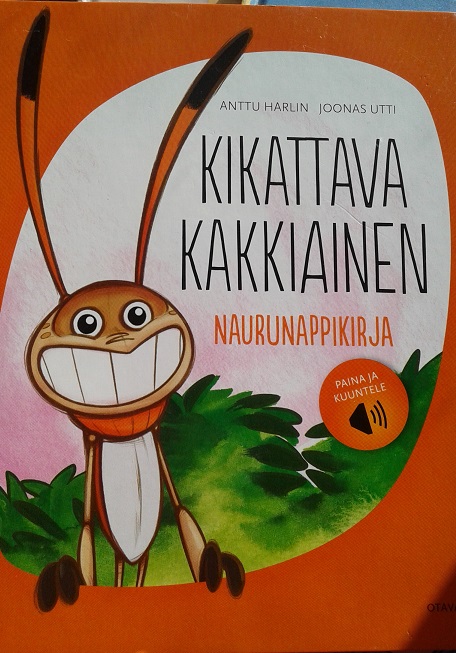
Anttu Harlin 2018: Kikattava Kakkiainen ja City-Kanin skeittilauta
Illustrated by Joonas Utti

Poppy Hedgehog wants to try out City-Bunny's new sled. Which of course is not s sled, but a skate board. City-Bunny is very proud of it and the others want to see, what it does. City-Bunny explains that it needs a hill, but every hill that the other suggest has something wrong with it: too small, too modest, too round, too lumpy and so on. 

Then Gigglebug has an idea: they can build one!  Together they build a roller coaster style "hill". Finally City-Bunny admits that he/she is scared. The others say they are afraid, too They ride toghether and have a time of their life.


This is the first "story"book about Gigglebug. the first being a think pages small children book. I am glad 

Music videos by GiggleBugVevo.

Wednesday, October 18, 2017

Emotional skills in a fun way

Anna-Maria Kuusela: Sisu Kettu ei anna periksi, Räyhä-Ravun kiukunpuuska, Kiva Kirahvin kannustus
illustraded by Matias Teittinen
expert: Maija Nuorteva

New concept for teaching kids to understand their feelings. Three books about Rounders, animals drawn in round shapes. Similar to Angry Birds. Very important lessons to be learned even for adults. The books include questions, which you can ask your kids. Such as "How does it feel to get a compliment?" "Why was Piggy so upset, when Crab yelled at her?" Again I am making up the gender specific pronouns, since the Finnish language does not recognize genders. The books are suitable for boys and girls.

Giraffe's pep talk.
The Rounders do not know what to do. They came up with creating a show. Everyone performs with the skills they have. Shy Penguin does not know what to do. Giraffe helps them all.
Look at those round flamingos!

The skills learned here are the power of positive words, overcoming fear and finding own strengths.


Brawling Crabs anger burst
Crab is almost always in crappy mood. He snaps (In my mind, it's a he, it could be as well a she) at everyone and makes the gentler animals cry. Then he feels bad. Luckily Smart Elephant gives him advice so he still has friends.

Skills learned here: empathy, considering other's feelings, apologizing and forgiving.


Crab makes Puspus the Fish cry.


Sisu, the Fox, does not give up
Sisu (The Finnish word for guts, resilience and toughness) finds a treasure map and all the Rounders want to go and find it. On the way, there are many set back, but toghether they continue. At one point most get tired and want to give up, but not Sisu. 

The skills learned here: helping others, sharing and recilience


Sisu does not let the blizzard stop him.


Tuesday, May 2, 2017

Pea soup fog

Tapani Bage 2010: Tahvo ja Bella hernerokkasumussa
illustrated by Salla Savolainen

Tahvo is a cat, who thinks he is a siberian tiger, Bella is a dog, who live on an island. One autumn day the fog is so thick, we Finns would call it pea soup fog. Tahvo and Bella collect drift wood from the shore.  The fog is cold and Tahvo wants to catch it and taste it. Does it taste like pea soup?

Suddenly they catch a penguin! He is Pablo and he wants to go back home to the Antarctic. Tahvo and Bella help him to find a vessel to get there.

The weather is always a good toppic to talk about. Usually the weather is too cold or rainy. On some rare occation we complain about the heat. The peasoup fog is where I live quite rare.  What I like about this book, is the cat who thinks he is something he is not and everyone else is ok with it and the mystique the fog brings and finally the helping others.

Tahvo is trying to get some of that pea suop.


Tuesday, January 3, 2017

Winter day

Hannu Hirvonen 2016: Päivä pulkassa
illustrated by Virpi Penna

Stuffed animals Eerik (dachshound), Reima  (horse) and Päkä (ram) are bored. Winter is so dull, there are no flowers and they just want to sleep.
Suddenly there are new kids with new stuffed animals from the city. Cute giraffe Sohvi makes Päkä blush and the dangerous wolf gets all of them exited about winter. They go tobogganing and skating. In the evening they bathe in sauna and drink hot chocolate by the fire. Winter isn't so bad after all!


Oh beautiful winter!
I am one of those people, who enjoy the change of the seasons. It would be so boring if it was summer all the time.

"Päivä pulkassa" comes from the age, when the farmers cut the sleds of the hired help to indicate that the work of the day was done. It literally translates the day is in the sled. Which in this book could mean that the toys spent the day in the sled.

Thursday, January 28, 2016

Aapeli and Veteran Reino

Maarit Malmberg 2010: Aapeli ja sotaveteraani Reino
illustrated by Jouni Koponen

Aapeli lives next door to a  retirement home. There lives Reino, who was in the Winter and Continuation war.

Aapli knows Reino and his dog Rauha. Aapeli visits Reino often and Reino tells him about his childhood in Carelia.

He tells Aapeli about the farm and all the animals they had. Aapeli knows that Reino is old and then Reino tells him about the war.


He remembers September 10th 1939, when he had just finished his army duty. Then he received a letter to join the army. The war hadn't started yet, but the recruitment was on already.

Reino explains about mobilization, shows him photos and tellss him about his duties in the war. He served as a medic and tells about the other boys and men, who got hurt. He even carried some of them to safety.

Aapeli asks, if Reino was scared. He says yes. Everyone was scared, those in the front and those back home. Aapeli asks, why he fought. Reino says he wanted to keep his home, which he couldn't keep. But he secured other homes. Aapeli's mother shows a map, where Finland was bigger.  Many people had to move, if they wanted to stay Finnish. Reino tells Aapeli that he was sad and mad, because he couldn't go home. But the most important part was that the war was over.

In Finland we talk about veterans, who fought in the Winter and Continuation War.  There aren't many left and I do not understand why we do not talk about the younger veterans who have served for the UN. I guess it needs more time.  This book is very matter of fact and even though it is about war, I think it is suitable to be read to school children. I know that many men and women who experienced the war did not like to talk about it. My Grandpa didn't.

Tuesday, January 5, 2016

Snow woman Amalia

Vesa Löhönen 2004: Lumiakka Amalia
illustraded by Jukka Laukkanen

Old man has been a widow for twenty years and hasn't found a new wife. His kids are constantly urging him to find a wife so he wouldn't be so lonely.

One day the snow is wet enough so he makes a wife for himself so he does not have to listen to his kids.


But the snow woman starts to talk to him.  The old man is worried. Hopefully nobody sees him talking to the snow women. That would mean trouble.

The Old Man's son comes to visit with his kids. His son is worried about this friendship between his father and the snow woman. He decides to play along and sends his father and Amalia a post card. Amalia is glad.


The story ends before we find out, what happens when the snow melts. But it is a nice story. Maybe the kids should not meddle with their parents lives.

Thursday, July 9, 2015

Day of magic

Kaisa Järnefelt 2014: Taikapäivä
illustrated by Riikka Jäntti


Maaria is spending time with her grandparents' house. She has imaginery friends: a horse named Rhubarb. With it Maaria attends summer wedding where many couples get married, also a frog marries a mouse.

It is magical to spend time with Grandma and Grandpa. Grandma is baking pastries and Grandpa can be mistaken for a sleuth, but he also takes Maaria fishing.


Grandma's red cottage

The book also includes short poems, including an ode to Grandma's cottage and the sleuth lying in the hammock.


My Grandma used to live in a red cottage like here in this book and she always had some pastries, such as the korvapuusti for us kids.  My mother makes the best korvapuusti in the world and my boys love them (as do their dad and everyone, who has ever tasted them).


Grandma baking lots and lots of sweet rolls.

I never had such an imagination as Maaria here in this book. But just a while ago my father came indoors with a spoon. He had found it near a big stone. I admitted that it must have been mine, because as a child I had thought that stone was a sacrificial stone and I had wanted to dig around it. (At the time I wanted to be an archaeologist.) Needless to say, my concentration was lost before I got through the weeds.

Monday, June 15, 2015

Gigglebug - laughbuttonbook

Anttu Harlin, Joonas Uitti 2015: Kikattava Kakkiainen

Gigglebug is playing with his/her friends. All it can hear is different laughter and when you turn the page, you can see, who made that sound.

Cute laughs, even though this book has thick pages, which in our house means its a baby book,  my five year old son likes this book.

We first met Giggle bug on an animation  at Pikku Kakkonen. I guess part of the charm is that "Kakkiainen" reminds us of  "kakka" which means poo. I like the delicate illustrations of the animation and this book.


Miss Hedgehog hiding in a mailbox. Mr. Moose in a bush.


 Gigglebug  also has a website.


Monday, April 20, 2015

Mill elf and a mouse

Tiina Tikkanen 2008: Myllytonttu ja hiiri
Illustrated by Satu Ilmonen

The old elf is visited by a hungry mouse. The elf is not pleased: mice cannot be in the mill messing things up. He takes the mouse in any way and shows him how the mill operates.

 One day the elf hears another mouse voice. Again the elf tells them that they cannot live in the mill. He knows that soon there will be baby mice running around.

 The miller finds out about the mice and sets his cat on the mice. The mice flee. The old elf is both happy for the mice but sad that his friend left.


Birdseye view of the mill
Elves are not just part of Christmas. People believed that there was creatures looking over a particular place like the mill. I especially like the rich oil painting style of this book. Now the value of old buildings have been noticed and places like this mill have become a new life.


The book is based on Töllin Mylly in Nummi-Pusula.The existing mill was built in 1922, but in the same spot has been Mills since the 19th century.


Thursday, March 26, 2015

Tales from the Home spruce

Riina Juvonen 2011: Kotikuusen tarinoita

Old Finnish proverb: “Sitä kuusta kuuleminen, jonka juurella asunto.” demonstrates the importance of understanding your origins and home environment (Basically: Listen to the spruce, under which your home is.) Three cute stories the home spruce tells everyone who wants to listen, every story has a lesson to be learned about friendship, kindness and understanding.


Otso dances with the fairy

The bear and the fairy 

Bear happily demonstrates his strength to others. It had nothing to fear, but neither had he any friends. One day Otso (one Finnish synonym for bear) sits on the meadow and is happy, but he has no one to share it with. He starts to cry. A fairy arrives from the Rainbow and does not know anyone. She asks, if she can join Otso and if he could teach the bear dance for her. All fairies at the Rainbow love to dance. Otso thinks this is strange, but starts to dance. It is fun and Otso forgets all his worries and dances with the fairy.

Other animals arrive, but Otso and the Fairy do not see them. None of them believe what they are seeing and start to laugh. Otso gets mad and runs to the forest. The fairy does not understand why Otso left and flies after him. Otso growls that he won’t dance: he is scary and powerful. The fairy tries to explain that even though he is all that, does not mean he has to be alone. The fairy was sent down to help him. Otso would have wanted another bear, wolf, wolverine or even a raccoon dog. Light fairy is not his idea of a friend. Otso yells at the fairy that she should go back to where she came from and tomorrow he will tear down all forest. Let them laugh at him then!

 In the morning the fairy tickles Otso’s toes. He has company. All the other animals want him to teach him how to dance. In the fall fairy has to move back to the Rainbow and Otso goes to hibernation knowing that the fairy will be back in the spring.

Snappy Ram and the cloud sheep 

Snappy gives grief to the weather elf
High on the sky promenade a herd of cloud sheep. The weather elf is happy with her sheep. Little Snappy is not happy, his mother had just upbraided him for picking on the other lambs. Snappy thinks he is the son of a thunder cloud and not cotton candy and decides to show the others that he can raise a storm as well.

The weather elf tries to stop him, but Snappy just huffs and puffs and shakes hail from his wool. It booms and makes lightnings. It breaks children’s sand castles and creates a mess at the beach, where people are enjoying a lovely summer day. Then he gallops to the fields. There his breaks the electric wires so the freezes melt, milk gets bad and all get wet. Snappy is now happy. The weather elf waits for him very sad, and so do the rest of the herd. Mother says Snappy has embarrassed them all. A real thundercloud refreshes the air, when the heat is too suffocating. The weather elf orders Snappy away from the herd, to the place where tornados, hurricanes and thrombuses are. Snappy is fine with that. The outback of the sky is gloomy. A strong tornado grabs Snappy and shakes him so that he feels sick. The others try to pull him a part too. Soon he is just lying there, alone and unhappy. He just wants to go home to mother. Snappy returns to the others shouting that he wants to be a cloud sheep and nothing else. All get happy and hug him. His father tells him, that a good sheep learns from his mistakes.

 Fox, Bear and the Snake tree 

The snakes have just woken up in the spring. Bear also smells the fresh air and stretches out on the ground, when a snake bites him. The bear gets mad: who dares to disturb him, the king of the forest. A fox hears him and comes to see. The bear’s ear is all swollen and he needs the forest elf’s magic lotion.

The animals discuss what to do with the snakes.
The bear summons all forest animals. The snakes need order and the bear suggest that they are exiled from the forest. The leader of the snakes defends them, that the snakes are very frightened and only defend themselves. The fox suggests that the snakes move to the tree. When there is no fear the snakes and the other animals get to know each other. The snakes help lost animals to find their way. In the fall the leader snake makes a nest next door to the bear. The bear is sure that next spring they can learn to live in peace. Friendship gets everyone to live in peace.


Thursday, July 3, 2014

Molli

Katri Kirkkopelto 2013

Molli is a creature that lives alone in a big house. Molli has surrounded its house with signs that say "Don't come", "Stay way". One day Sisun knocks on its door. (It isn't specified, if  Molli is a boy or a girl. The pronoun hän is used for both. That is why I use "it".)

Molli is upset and chases Sisu away. Soon Molli feels lonely. It starts to study what it takes to be friends. " The best gift that you can give to a friend is a smile and laughfter." But Molli cannot smile. It practises is. Then starts the long wait. Nobody comes. Molli even changes the signs to "Come" and "Don't  stay away". Then one day Sisu returns and Molli has a friend.
All Molli's family have grumpy expressions in the pictures
Molli in Finnish means minor in musical terms. No wonder it is a little melancholy with a name like that! Sisu means guts and courage.

The illustration is delicate and very detailed. I especially like the family portrates, where no one smiles. It is just like our family. I do not understand it, photos have been taken for over hundred years but in my family it seems that taking pictures is comparable to going to the dentist.


Monday, April 28, 2014

Pessi and Ilusia

Book cover illustrated by Kristina Segercrantz
Yrjö Kokko 1944

Pessi and Illusia is a story about a fairy (Illusia) that lives on rainbow. Illusia comes down to earth and meets Pessi, a troll, whose name is short for pessimist.  Illusia has "a smile that warms like the rising sun". Illusia stays so long that the sun sets and she can’t see the rainbow anymore.

The next few days are so dry that the rainbow never appears ,then comes a spider that envies Illusia’s famous father, Illusion, and bits off Illusia’s wings. Now she can never get back on the rainbow.

Pessi tries to make Illusia feel at home, but winter is coming. Luckily the forest animals help them: a muskrat digs them a hole and birds teach them to make a soft bed. Pessi also kills an evil weasel and a mouse makes a fur coat for Illusia.

 In the spring Illusia is very sick, but turns out she is having a baby. A new creature is born: a hairless troll.
Pessi and Illusia decorating their home
(Illustration by Kristina Segercrantz)
Pessi takes care of Illusia
(Illustration by Kristina Segercrantz)
The fairy tale has the following chapters:
Missing fairies
Briefbearer Bumblebee
Cross Spider
Crayfish and seashell
Sundew and drone
Daphina and heath spotted orchid
Cuculus
Woodpidgeons
Miss Cuseuta and Princes Centaurea
Human and goose
War of the frogs
Jay and Muskrat
Surnia
Weasel
Mountain Ash
New Human
Wings
Heath spotted orchid
(Photograph by Yrjö Kokko)
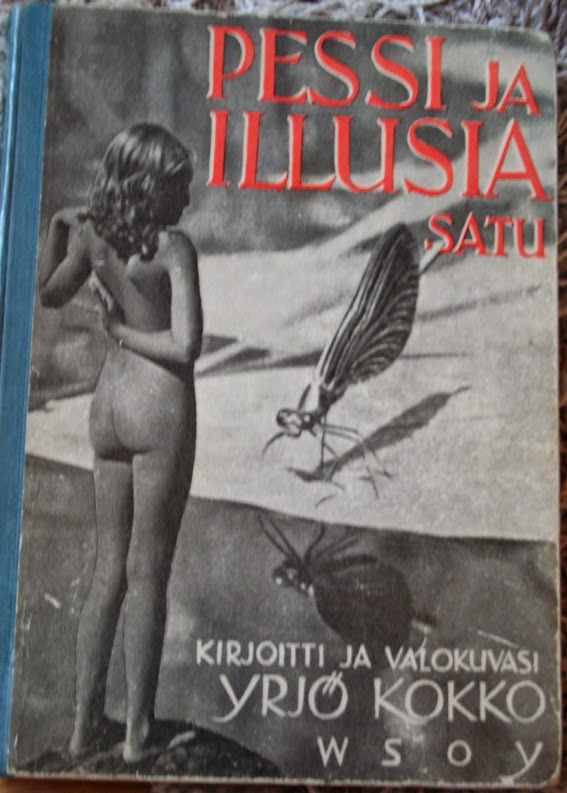
Cover of th e1963's edition
(Photograph by Yrjö Kokko)
In the animal stories, frogs think they are related to humans, because both have calves and then one of the frogs start to think that that is not the case and a religious war starts,a muskrat wants to be called a small beaver and a jay is the forest gossip. At the same time, the soldiers find pearls inside the mussels and pick peat, where the sundew lives. The war is very present in this story. In the final chapter, Yrjö Kokko tell about his vacation from the war and how his family is waiting for him.
Cross Spide (Photograph by Yrjö Kokko)
Yrjö Kokko was a vet and he had studied in the 1920's in Tarto, Hannover and Vienna. He also was a passionate photographer and he illustrated his book with photos. His occupation explains why he uses Latin names for the animals in Pessi and Illusia. He describes the nature beautifully:  "Cloud slept on the surface of the lake and even the shadows of the reeds were yawning."

Book cover illustrated by Aleksander LindebergPessi and Illusia meet
(Illustration by Aleksander Lindeberg)
 The story has been illustrated three times: first illustrations were photographs Yrjö Kokko took, the second has illustrations by Aleksander Lindberg and the third has illustrations by Kristiina Segergranz.