Wednesday, June 24, 2015

Saippa : saimaannorppa = The Saimaa ringed seal

Sari Kanala 2015
English text: Erja Mononen
gouaches by Daga Ulv
photographs by Juha Taskinen


As the title reveals, the main character is Saippa, the Saimaa ringed seal. The book tells the how Saippa lives his/her first year at Saimaa.

The book is illustrated with gouaches as well as photographs and the texts are both in Finnish and in English.

Mama seal giving birth
The story starts when Mama Saimaa ringed seal gives birth to her cub in a pile of snow.  Obviously there are no photos of that, but the illustration is charming.

At the end of the book is more information about the other seals living in Finland. And the facts are checked by the ringed seal scientists.


Seals on Saimaa.
Maybe I am a bit  fixated with the ringed seals.  Earlier this year I blogged about another seal. But it is easy. They are so cute and adorable. It seams that the less attractive endangered species do not get such attention. It is a cruel world.


Monday, June 15, 2015

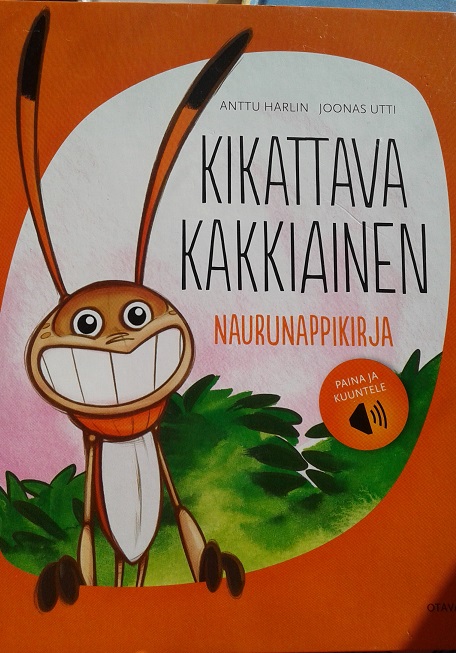
Gigglebug - laughbuttonbook

Anttu Harlin, Joonas Uitti 2015: Kikattava Kakkiainen

Gigglebug is playing with his/her friends. All it can hear is different laughter and when you turn the page, you can see, who made that sound.

Cute laughs, even though this book has thick pages, which in our house means its a baby book,  my five year old son likes this book.

We first met Giggle bug on an animation  at Pikku Kakkonen. I guess part of the charm is that "Kakkiainen" reminds us of  "kakka" which means poo. I like the delicate illustrations of the animation and this book.


Miss Hedgehog hiding in a mailbox. Mr. Moose in a bush.


 Gigglebug  also has a website.


Monday, June 8, 2015

Where does food come from? Frankfurter on a plate

Elina Lappalainen 2015: Nakki lautasella
Illustrated by Christel Rönns

How to tell kids about food? This book tells a story about ordinary Finnish farms.


The vet takes Akseli and Emilia to see cows, pigs and chicken. The kids learn how much manure one cow produces per day, where do eggs come from.  The book shows animals as valuable sources of food.

Finnish kids (and adults) do not know anymore where their food is coming from.  I expected this book to be more shocking, but it nicely told about the animals. No pictures about slaughter or decapitating chicken. The book is very informative and matter-of fact, but I feel something is still missing. The book doesn't explain why some farmers abuse their animals and animals actually suffer before they are made for food. Also the personalities of the animals are just explained as species trait.

Why is the boy always the prejudice in children's books? Are all afraid that the girls are being belittled by such remarks? Also the boy usually asks the stupid questions? Isn't it appropriate for the girl to be silly?

The final remark, that at Aleksi's and Emilia's home they only eat happy animals. Who eats the unhappy animals?


Monday, June 1, 2015

Peter Robin puts out a forestfire

Tapani Karinen 2008: Pekka Punarinta sammuttaa metsäpalon

Peter the Robin is a very lively little bird. While playing in the forest with his friend, he sees an open fire. All animals panic and try to figure out what to do.

Peter takes action and puts out the fire, before the whole forest is on fire.

The very high lighted message of this book is that stupid humans left the campfire smoldering and did not put it out properly. Kids remember to take care of the nature.


This book is published in this century, but it reminded me of the books I used to read back in the 80s. I guess there is still need for educational stories. I also like the illustrations of this book. 


Monday, May 25, 2015

Ragline

Annika Sandelin 2010: Businnan
illustrated by Linda Bondestam

Annika Sandelin 2011: Businnan blir kär
illustrated by Linda Bondestam

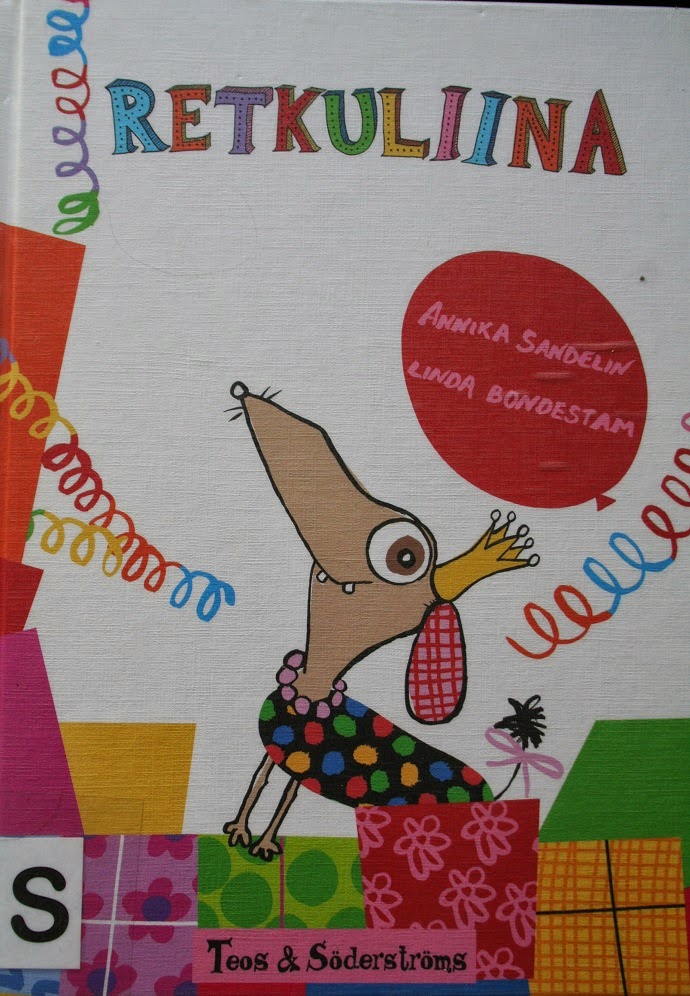
Ragline (Businnan/Retkuliina)


Ragline  is a plush dog that has been thrown away,  but luckily Petra has taken her in. Ragline (Businnan in Swedish, Retkuliina in Finnish) is very selfis and high maintenance plush toy and she has to find her place among the other toys and where nobody appreciates her need to be the center of attention. The others are soon ready to throw her back on the street again.

Ragline enjoys the swings
Luckily Ragline is so loveable that she gets to stay.

Lessons about accepting others the way they are, but also not being a dive.


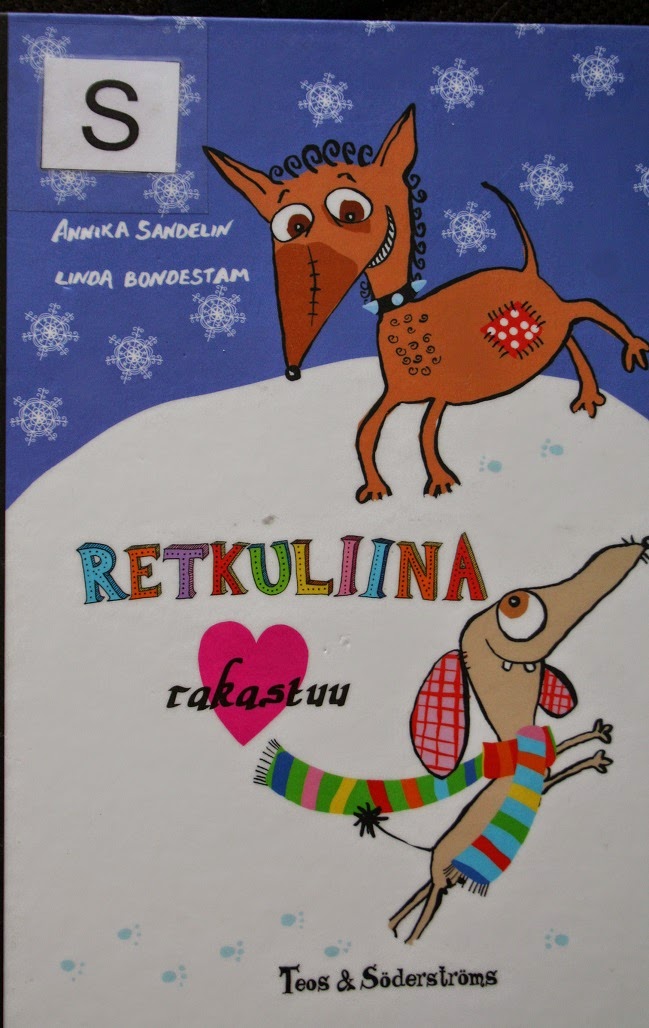
Ragline falls in love (Businnan blir kär)

Ragline meets Rackham a very charming boy plush dog and together they run away.

While Ragline is romacing with Rackham, Petra is very sad because she left. Petra's other toys at first are glad but then start to miss her as well. The house is boring without Ragline. Ragline soon sees that life isn't as rosy as she thought it would be and returns home a lot fatter. It turns out she is going to have a puppy.

The second version reminds me of Disney's Lady and the Tramp, but with a Kaurismäki twist: the male always leaves! That is too rough. I prefer the Disney version, but the perspective is good and so is the lesson: beware of these charmers!


To really charm Ragline, Rackham takes her to the garden.


Thursday, May 21, 2015

Nightowls

Laura Ruohonen 2008: Yökyöpelit
Illustrated by Erika Kallasmaa

In a mysterious building no one sleeps at night: flues sigh, the elevator is coughing, the basement door squeeks. The master spy agent genious Naru  creeps and investigates. Five small Nieminens eat only the holes from the bread. Grandma Ant remembers her millionth husband.

Nasty lime is waiting to be wed, the Rastafarians bathe with bouquets of birch branches (vasta) and the headlouse is just waiting for kids to feast with their blood.


The nasty slime (Imulima) is waiting for a wedding.

Based on this book is also created a tv-series Yökyöpelit by YLE  that was favourite to our boys. I must admit that the phonetics are cute with imulima and päätäi Väätäinen. Is this what it is like to live in an apartment house? Maybe not, but it sure is entertaining.

The rastafarians in sauna.


Monday, May 18, 2015

Pixon brothers and the homely glow of TV

Malin Kivelä 2013: Bröderna Pixon & TV:s hemtrevliga sken
Illustraded by Linda Bondestam


The four Pixon brothers love to watch TV and eat candy and chips. One day the TV does not work anymore and the boys have to come up with something else to do.

That is a bit troublesome, since they have the muscles size of a pea, but they do come up with imaginative things.

The books is a great example and an exaggeration of what happens when you watch too much TV. I guess the same goes for too much video games or playing with your phone. Exaggeration is a fantastic way of making a point and the illustrations remind me of the Addams Family.

I personally think the TV and actually the Finnish National Broadcasting Company have done a great job at least in educating people in languages: the foreign TV programs have subtitles and therefore we hear all possible languages from Chinese to Danish.  I started learning German with die Schwarzwaldklinik. But then again it is wonderful to watch TV in Germany, where  Fran Drescher and other Americans speak German.


Thursday, May 14, 2015

Allan and Udo

Minna Lindeberg 2012: Allan och Udo
Illustrated by Linda Bondestam

 Allan and Udo have been a couple a long time now. But it is not always easy to be together, when you are totally different from the other.

On Christmas Eve Udo refuses to celebrate . He has had a long carreer in the military and now he is depressed. He is going to sit in the kitchen until Christmas is over. Allan is sad, he knows how hard it is to cheer up someone who is depressed.

Allan lures Udo to dream land In dreamland anything can happen. Old men can fly, cakes do not have bottoms and a mysterious baker is sneaking around and getting Udo to forget Allan.  Udo tries to get away, but cannot. Allan comes to the rescue and  Udo remembers all great memories with Allan.

When they wake up, they go for a walk and see the stars and everything around them is wonderful again.

The book deals with how difficult it sometimes is to play together, how sweet sorrow memories can be and how dreams have a logic of their own. The book tells us how it must feel like to grow old, when all your dreams are behind you. In best cases as memories. It reminds us not to take those who are the dearest for granted.

This book was selected as one of the most beautiful books of 2011 and the most refreshing thing is that the relationship of the two men isn't explained in anyways. I wish that was the case in modern Finland as well, where still being different is not welcomed.


Monday, May 11, 2015

Funnytassel


bunny train
Funnytassel's train ride
Lauri Hirvonen:
Hupsutupsun junamatka 2009
Prinsessa Hupsutupsu ja lohikäärme 2011
Huptutupsu perustaa orkesterin 2012


Princess Ladybug, bunny
Funnytassel meets Princess Ladybug.

 Funnytassel's train ride


Funnytassel and her family are taking the trai to see Grandma. Funnytassel takes her Teddybear and Pony with her. The train ride takes all night and during the ride Funnytassel gets to know Princess Ladybug, the singing conductor and many forest animal.
 
Bunny pretends a lizard is a dragon
Princess Funnytassel and the dragon

Princess Funnytassel and the dragon

Funnutassel makes a crown from wild flowers and the lizard in the garden gets to be the dragon. Funnytassel examines bugs, blows soap bubbles. Suddenly there is light summer rain, but it doesn't matter after the break the make believe game is even more fun.


When it starts to rain, Funnytassel has to go inside.
Funnytassel's orchestra

 Funnytassel's Orchestra

Funnytassel (Hupsutupsu) has a new baby brother, who is still too small to play with her. Funnytassel feels a little grumpy.

She accidently dropps a spoon on a plate and it makes a lovely sound. What other could be used as a musical instrument?


Funnytassel investigates what else can be used
as a musical instrument
Soon Funnytassel is playing the cardboard boxes, yoghurt containers and rubber bands. Only thing missing is a lead singer. Funnytassel's little Brother Tasseltoo (Tupsutuu) turns out to be quite a vocalist.


Cute stories about everyday life. Many Finns have Grandparents living a long train ride away. So the ride there is always a bit of an adventure. In the first book Funnytassel and her family are spending the night in the train, so Grandma must live very far away.

The train puffs through the forest
The second story is about using one's imagination. What would be a better place than a garden? A little positivism is also seen in the rain: it gives a nice break. The last book  comforts those who have recently received a sibling. It's not all bad after all.


Thursday, May 7, 2015

Anni and the wolf

wolf forest girl
Anni and the wolf cover
Anu Jaantila 2000: Anni ja Susi
photos by Timo Viljakainen

Anni wonders to the forest and falls asleep. A wolf finds her and after both overcome their fears they become friends. The wolf helps Anni back home.

After the story Kaarina Kauhala tells about wolves' lives. 

At the end of the book reads that the wolf used in the pictures is actually part wolf and part dog. 
wolf girl
The wolf finds Anni sleeping

Finnish people are afraid of wolves and at some parts it is justified. Although it is strange that the media is willing to feed that hunger by telling the stories of how wolves attacked sheep or reindeer. I am not sure how it should be handled, on the other hand people have the right to know.

I am sure the intention of this book was to make wolves less scary, but one thing bother me in this book: if a child should meet a wolf in the forest, what should he/she do? Be friends with it? Aren't the lone wolves the most dangerous?