Showing posts with label Christel Rönns. Show all posts

Thursday, January 3, 2019

Ricky the Rapper in traffic

Sinikka Nopola and Tiina Nopola: Risto Räppääjä liikenteessä
illustrated by Christel Rönns

I am glad kids are taught how to behave in traffic, since so many adults do not. This book is makes adults look silly and it is always a big hit with the kids.

The book teaches the basic traffic signs, the rules who goes first. But at least I tell my boys that in a match between a car and a pedestrian, the pedestrian always looses. The same goes for bikes. So I cannot emphasize enough that boys should be careful. You can never be sure that the drivers see the kids.

One thing that is missing from this book and is driving me nuts is in trains: people start pushing in the train even before the other people have come out! Come on.  Where are the manner schools for adults?

Visualization of Risto without reflector in
  the first picture, and below with reflectors
 and a head lamp.
In winter time  two things should be remembered: it is dark and slippery. Some how people always forget that and come November many accidents happen.

So, keep your reflectors and even lamps when you walk out side. Even in cities the street lamps only light a limited area and the people blend in the shadows.

Sometimes we get snow and the snowplow truck keep the streets clean.  In the country side, where there are no sidewalks, change sides when the truck approaches, or you'll end up like Aunt Rauha at the bottom picture.

Also the streets are very slippery, so be prepared that the cars may not stop as fast as in summer time.  So when you are walking, keep that in mind.

My favorite advice in traffic: no sudden moves! That eliminates some accidents.


Watch out for the snow plow truck!
Now, what can you do?

Wednesday, April 19, 2017

Nepi the corgi

Tittamari Marttinen: Nepi ja paras koiravahti 2009
and  Nepi onnenkoira 2010
illustrated by Christel Rönns


Nepi and the best dog sitter ever
Nepi is a corgi, whose owner is very busy.  When the owner goes to work, Nepi is taken to the neighbors. One is too lazy, just eats junk. The other is too active, Nepi is exhausted.  The third one dresses Nepi up, so that he feels the other dogs are laughing at him. Finally there is  Alma, the girl upstairs. Together they go to the dog park, take naps and have fun. The best dog sitter ever!


Nepi meets Alma.
Nepi, the lucky dog
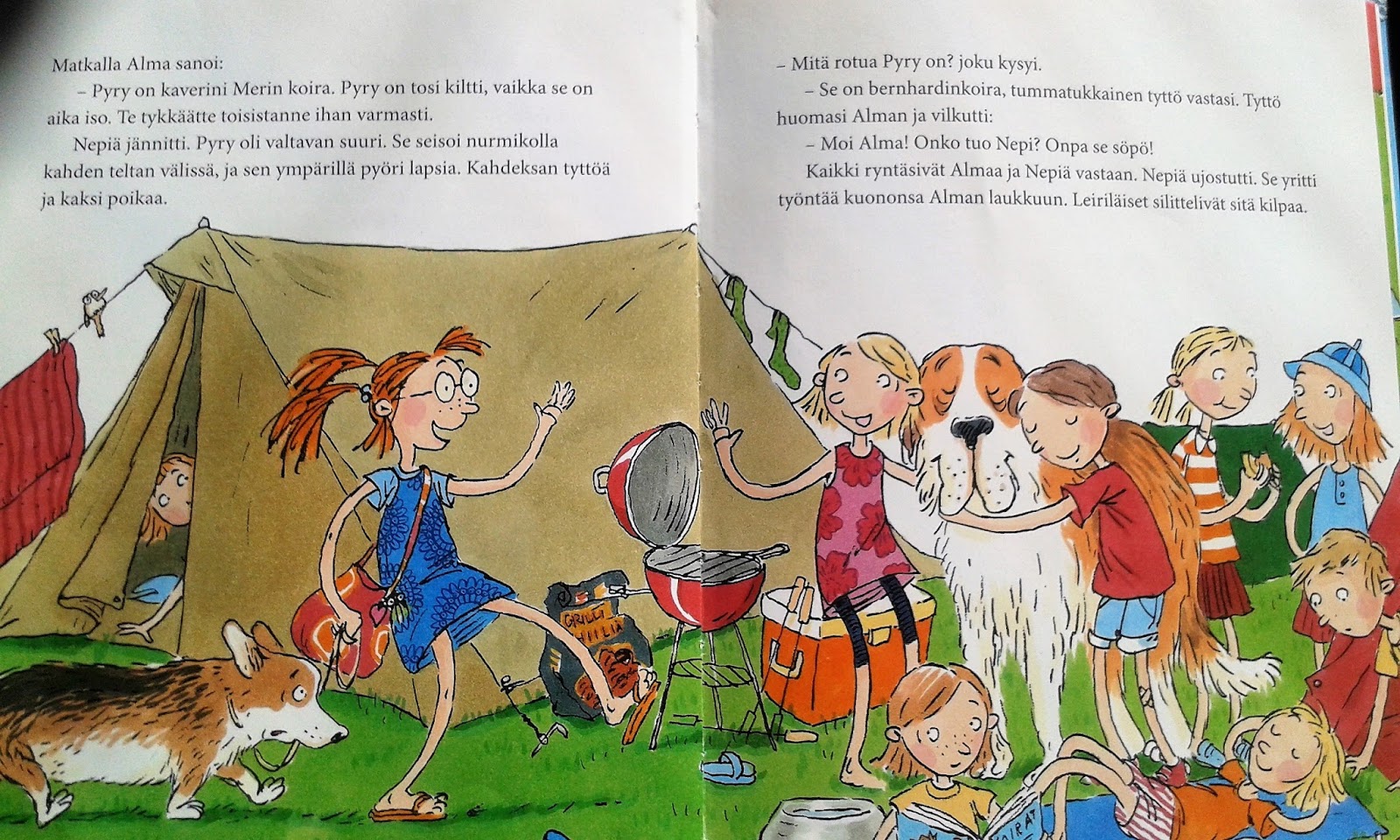
Alma is taking Nepi to a field trip to a summer camp for schoolchildren. There they meet other kids and their dog, a Saint Bernard named Pyry. The Saint Bernard is a hero, it used to live in Lapland and it saved people from the avalanches. And he is huge. Nepi feels himself a little small. He had never saved any lives. Everyone loves Pyry. Nepi wants someone to tell that they love him, too.


Nepi the lucky dog
The next day Alma takes Nepi to the beach. There they meet Enska, a  pug. His owner says he is a champion and Nepi feels jealous. He picks on Enska, who gets really sad.  Nepi feels awful and appologizes.  They find a common note and start playing with each other.  At home Nepi tells his owner that he wants to be something special. His owner keeps telling him, he is special. In any case, Nepi decides he can do heroic acts himself.  He helps the old lady next door to open the trash and a young mother to catch her toddler.  Later he saves Alma, or he thinks so, Alma is only doing somersaults in the water.  Alma says that Nepi saved her from boredom and loneliness.

Cute stories about a dog. Which could easily be identified as a child. I do not know, how children relate to these stories, but as an adult I see the great lessons in both of these books.  And corgis are cute too


Nepi and Alma at the camp with Pyry


Tuesday, September 27, 2016

What a visit to the museum

Anna Finnilä, Jere Jäppinen, Elina Kallio and Hilkka Vallisaari 2011: Melkoinen museoretki
illustrated by Christel Rönns


Helsinki City Museum turned hundred in 2011 and to celebrate they wrote a book about behind the scenes for children.

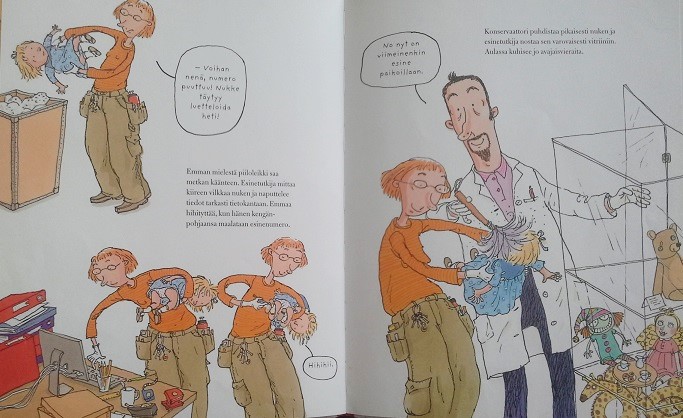
In the book  Aunt Johanna takes Otto and Emma to visit the museum.  The museum is opening a new exhibition and Emma gets lost when she is falls into a moving box. Johanna and Otto try to find her. The look into the picture archive, work shop, map room and research lab.

Emma is finally found in the exhibition, where she pretends to be a doll. Aunt Johanna needs a relaxing bubble bath after the visit.

Museums are great. In Helsinki most of them are small enough for an hour visit as a comparison to the Heremitage or other huge museums that take a week to visit.


Wednesday, June 8, 2016

Angry bag of Cat Killi

Tuula Korolainen 2007: Kissa Killin kiukkupussi
illustrated by Christel Rönns

Cat Killi has a temter tantrum as soon as he gets out of bed. Breakdast sucks and everything is wrong. The house elf gives him a bag, where he can blow his bad temper into.  Kiukkupussi in Finnish means also a person that has a bad temper.

Killi goes out doors and meets dog brothers who are arguing and after they blow into the bag, play nicely with each other. A sheep is fighting with his car and Killi helps him to be in a better mood. Finally Killi goes into a soccer match, where every one are shouting at each other. Killi's bag gets really big and it is punctured by a crane.


The lesson here is that kids are always taught to control their temper, but in this book it is the adults that need the control more then the kids. And how are the kids supposed to learn, when adults are throwing temper tantrums?

It is ridigulous, how the tempers rise in trafic and in sports events. It is as if our generation were not taught enough to deal with our feelings and then they explode in sports events and traffic. Parents, take a note and pay attention to your own behavoiur.


Monday, June 8, 2015

Where does food come from? Frankfurter on a plate

Elina Lappalainen 2015: Nakki lautasella
Illustrated by Christel Rönns

How to tell kids about food? This book tells a story about ordinary Finnish farms.


The vet takes Akseli and Emilia to see cows, pigs and chicken. The kids learn how much manure one cow produces per day, where do eggs come from.  The book shows animals as valuable sources of food.

Finnish kids (and adults) do not know anymore where their food is coming from.  I expected this book to be more shocking, but it nicely told about the animals. No pictures about slaughter or decapitating chicken. The book is very informative and matter-of fact, but I feel something is still missing. The book doesn't explain why some farmers abuse their animals and animals actually suffer before they are made for food. Also the personalities of the animals are just explained as species trait.

Why is the boy always the prejudice in children's books? Are all afraid that the girls are being belittled by such remarks? Also the boy usually asks the stupid questions? Isn't it appropriate for the girl to be silly?

The final remark, that at Aleksi's and Emilia's home they only eat happy animals. Who eats the unhappy animals?


Wednesday, December 3, 2014

Tarlena, the Elf-girl on a journey to Christmas

Elina Karjalainen 2003: Tonttutyttö Tarleena matkalla jouluun
Elina Karjalainen 2006 : Tonttutyttö Tarleena ja talven ihme

illustrated by Christel Rönns

Tarlena, the Elf-girl on a journey to Christmas
Mama Maxim is loved by all in the village of Birdsong. One day she finds a little elf girl crying in the forest. Tarleena the elf girl is lost and Mama Maxim takes her home until Tarleena is found. Tarleena makes friends with a fairy Blue wings and the decide to go to school.


Mama Maxim and the elves celebrate Christmas.
Meanwhile Santa is worried: Tarleena is the one who wraps Christmas presents and she is no where to be found. He sends a search party to look for her. Tarleena is enjoying her stay at Mama Maxims, she helps with the chores, plays with Blue-wings and the village kids.

Finally the search party finds Tarleena. Mama Maxim suggests that the elves celebrate Christmas with her, get rested and then go back to Korvatunturi. Mama Maxim does not want to be alone at Christmas. Blue-wings suggest that they celebrate Christmas now, even though it is not quite Chrismas yet. Everyone gets busy with the preparations and soon they are dancing around the Christmas tree. The elves return to Korvatunturi and Tarleena promises to visit Mama Maxim.

Tarleen, the elf girl and the miracle of winter
Tarleena is visiting Mama Maxim. The winter is still holding its freezy grip on the nature and fairy Blue-wings cannot be found anywhere. Blue-wings is needed to chase the frost away.

Tarleena asks for help from all her friends and soon even the smalles creatures are looking for Blue-wings.

Finally and at the last minute birds find the fairy nearly frozen in the forest. Luckily Mama Maxim knows how to defrost fairies.


Tarleena is looking for Blue-wings


Thursday, June 5, 2014

Tiitiäinen


Tiitiäisen satupuu (1956)
Tiitiäisen pippurimylly (1991)
Tiitiäisen tuluskukkaro (2000)
Tiitiäisen runolelu (2002)

Tiitiäisen satupuu ( 1959, The fairytaletree of Tiitiäinen)
Illustrated by Maija Karma.

Finland’s most beloved nonsense poem collection from 1956. The collection has 43 poems. This is a timeless classic that fascinates kids today as well as their parents and grandparents. The most famous characters are Haitula, Tiitiäinen itself, Emotional hedgehog, Mr. Pii Poo and Ville and Valle.

With this collection Ms. Kirsi Kunnas modernized Finnish childrens Lyric poems. She used the English Mother Goose as her inspiration. Before Tiitiäinen, the children’s poems had predictable rhymes and very educational attitude.

Ms. Kunnas wanted to cut loose from all that. Her poems are full of linguistic play, humor and satire that address both adults and children.

Metsähiisi
Tiitiäinen is a gnome, a forest creature, whose cheeks are made of lingonberries, hair a bobble of lichen. Eyes are blue stars. Tiitiäinen, swings at the spruce’s arm, sleep at the manor of the wind. Turn the blue stars out.

(Loosely translated from Tiitiäinen, metsäläinen by Kirsi Kunnas)

Tiitiäinen, metsäläinen
Tiitiäinen metsäläinen, pieni menninkäinen.
Posket on tehty puolukasta, tukka naavan tuppurasta,
Silmät on siniset tähdet, silmät on siniset tähdet.
 Tiitiäinen metsäläinen, pieni menninkäinen.
Keinu kuusen kainalossa, tuutu tuulen kartanossa,
Sammuta siniset tähdet, sammuta siniset tähdet.

Tiitiäisen pippurimylly (1991, Peppermill of Tiitiäinen) 
Illustrated by Julia Vuori
Undertitle: Not to too small or too big, but to all who have a peppermill.

The poems in this book are shorter than in the first book. Only Ville and Valle and the Waterrat appear in this book. The title sets the tone: the language is grinded in short poems rather than in fairytales. The poems deal with life phenomena or a word that is first wondered and then laughed at. The whole story strats to unravel and becomes nonsense. These poems have more rhymes that the first book, but just as the reader gets a hold of the rhyme, it is broken again.

 Eli Lievestuoreessa tuore lipeäkala, 
läpikotaisin kipeä kala.; 
Kun sataa noita-akkoja ja hirveitä hirvenkakkoja - -; 
Kun kuu on puoliksi valkea ja puoliksi musta, 
on kumma ettei se halkea ja herätä kummastusta. 

This collection has 85 poems that are categorized under eight titles. Each category has its own themes, there are hilarious characters, odd things, car poems, cat and mouse poemsl, weather and animal poems.


Tiitiäisen Tuluskukkaro (2000 Flint bar purse of Tiitiäinen)
 Illustrated by Kristiina Louhi


Alphabetical poems. That happens to guinea pig and walrus in Mercedes (Finnish marsu, mursu and Mersu)? The circus is also in town and an onomatopoetic worm. (mato is worm in Finnish). The word play captures the attention of even the young readers. Wordplay at its best.


Guinea pig and walrus in Mercedes


Tiitiäisen Runolelu (2002, Poem toy of Titiäinen) 
Illustrated by Christel Rönns

This book has 15 poems from other Kirsi Kunnas poem collections. The poems are turned in to finger plays to create a connection between touch, voice and words. The book includes even a Finnish version of Hickory Dickory Dock.
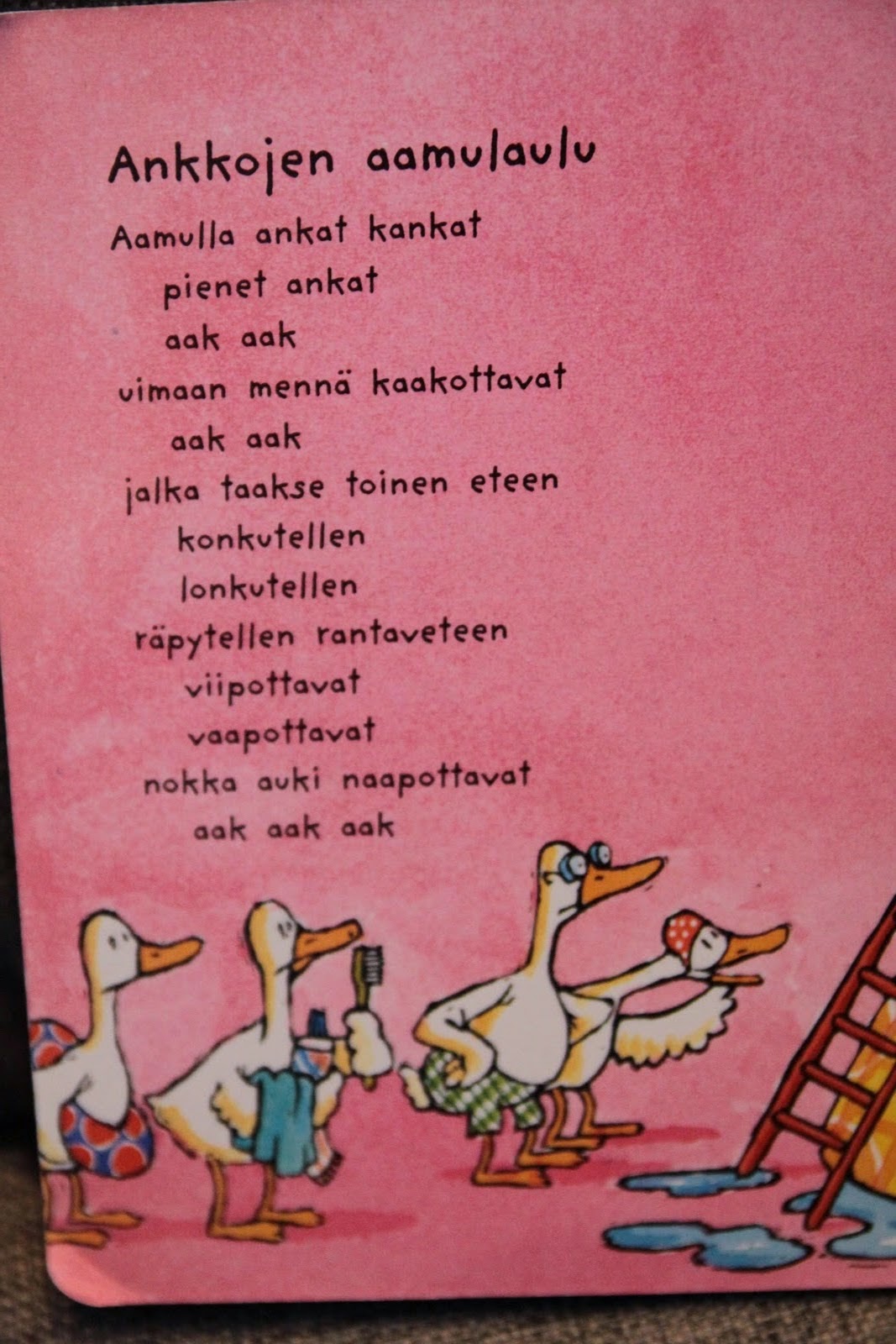


Ducks' morning song
 The poems in this book:
Sormiloru (Fingerpoem),
Tänään (Today),
Hikkori tikkori toikki (Hickory Dickory Dock),
Jänöjussi Puputti ( Bunny Puputti),
Hoppeli Hopp,
Ankkojen aamulaulu (Ducks’ morning song),
Metsäsianpossuntossu (Forest pig’s piglet slipper),
Tiitiäisen tuutulaulu (Lullaby of Tiitiäinen),
Nuku nuku (Slepp, sleep),
 Aa aa lapsoseni,
 Niityllä pipipilipom (At the medow),
Kissat ja hiiret (Cats and mice),
Wow Wow,
Iloinen auto (Happy Car),
Kysymyksiä ja vastauksia (Questions and answers)