Tuesday, November 29, 2016

Animal poems

 Jukka Itkonen 2016: Hirvi irvistää
Illustrated by Matti Pikkujämsä


The name of the book in Finnish means moose grimaces.  Later on you learn that tit grimaces to a cow that came to forest to his turf. Cute short poems about animals from moose to ants.


Lynx lynx is probably the only animal
all Finnish know in Latin.
I am becoming a fan of the modern children's poems. Before the poems were too educational and moralizing, but now they are just fun. Of course, you can still learn a thing or too.

Tuesday, November 22, 2016

Crackbrained crustacean

Anneli Kanto 2014: Älytön äyriäinen
illustrated by Kaisa Riekkinen


Alphabet in cute animal limericks.  We learn about the greedy wolverine (ahne ahma), Colorado beatle (very scary for potatoes), Reindeer and pike pearch (written with q qha when it is spelled with kuha), bug in Ooland (ötkkä Öölannista).


Not only do we learn about the letters, but also places like Urjala, Lieksa, Kerimäki. Even my boys listened carefully, which you have to do in order to really get what is being said.


Qhalla on nuha. (The pike pearch has a flue)
 Even z and x find an animal: zz fly and Räxy (fieldfare). Very clever and Merikåtka (whitetaled eagle) has the honor to be written with swedish o, when it really shoud be spelled with regular o. It makes the bird more distinguished.


Tuesday, November 15, 2016

Helsinki before Helsinki - the archeology of the old city in comic

Jaana Mellanen 2014: Helsinki ennen Helsinkiä - Vanhan kaupungin arkeologiaa sarjakuvina

Very informative comic about old Helsinki, before it was our capital. The old Helsinki is not there anymore, it is underground.
Helsinki was grounded in 1550 by Swedish King Gustaf Vasa and it was just like the other cities: groups of gray log houses, church  and town hall in the middle. The blocks followed the forms of the land.


The comic is a mix of present day archiologists digging and the past people living in the old Helsinki back in 1550. The book is also illustrated with images of the artifacts from the digs and illustrations of the buildings that used to be.

The most important things were a well, which provided fresh water, the church, which was documented since the clergymen were almost the only who could write.

First church of Helsinki, which was burned in 1670s.
Some information was also found about the clothing, which people wore, the jewellery (read iron decorations not gems or gold).

One section focuses on the food and drink and the items associated with it.

The book has a nice mix of comics and photos, making the story alive. A great book to learn about Helsinki.


Map of Helsinki 1645. Only the church is drawn.

Tuesday, November 8, 2016

Summer at Villikka

Mysi Lahtinen 2010: Villikan kesä
Illustrated by Virpi Penna

Villikka is a part of the city located on an island. Not even a bridge connect it to the city. Back in the day people only lived there during the summer. One family even wanted to take their piano to the island for their vacation. Nowadays there is a bridge, but the wood villas are still surrounded by greenery, big trees and even a forest.

Five friends Riikka, Essi, Tilli, Olli and Aarne are spending the summer in Villikka. Riikka and Essi are sisters, Tilli and Olli are cousins.


Waiting for the miracle of Mid Summer Night
The kids find out about making willow whistles, nettle crêps and growing vegetables. They hear stories about the leprecaun's treasure, celebrate Mid Summer and hearing about the different beliefs.

When it rains, the children spend time at the attic, playing boardgames, making up stories. Then they make fishing rods,build sand castles and eat lots of ice cream.

In November, it is nice to read books about summer. I feel that most people are hibernating in winter so they have energy for the summer to really live and do things.


Thursday, November 3, 2016

Elsa and Lauri at a party

Kerttu Ruuska 2016: Kerttu ja Lauri juhlissa
illustrated by Nadja Sarell

Elsa and Lauri hav been invited to Grandma Selma's birthday party and they make the gift themselves. They collect stones and braches from the nearby forest and then work by themselves for a long time.

On the special day, the comb their hair, put on their best cloting and shoes. Mother explains that is how they honor Grandma on her special day.

At the party they give the present to Grandma and then greet other people at the party. Elsa and Lauri are a little shy, since they do not know many of the people there.


Mother gives a speach at the birthday party
Uncle Antti and cousins Topias and Aava have prepared a song for Grandma and after that Grandma invites every one to the buffet (seisovapöytä, which means literally standing table. Silly, but what can you do). Mother tells Elsa and Lauri to taste new foods, when Lauri announces that he does not like salad.

At the table Mother klings her glass and gives a speech.  The kids are excused and go play in the play house. Then Grandma opens her presents. When it is time to leave, Elsa, Lauri, Mom and Dad thank Grandma and say good night.

At the end of the book are sections about family tree, preparing for a party, etiquette of how to behave in a party (remeber to congratulate the birthday person, shake hands or hug other guests, suggestions of what to talk to the other people about, thanking for food, be silent when some one is presenting somethin) and a list of different parites (Babtisms, birthdays, confirmation, graduation and a wedding).

This is a great book that every parent should read. I am so old school that I do not think jeans are suitable party attire, every one should be greeted and kiitos ( thank you) is the most important word ever. We have had all the above mentioned parties this year: two graduations, one babtism, one confirmation, several birthdays and a wedding. I hope that some of the manners I have been trying to teach my boys has caught on.


Thursday, October 27, 2016

Time travel of museum mice

Kirsti Manninen 2010: Museohiirten aikamatka
Illustrated by Inge Löök
Swedish translation Thomas Rosenberg


Aino and Väinö are small mice that one spring morning clean the museum chest. They found a paraso that they take outside. They see text that says Porvoo and Loviista. All of a sudden the wind takes the paraso and the mice up in the air.

The parasol takes them to
Sibbesgården
Sipoo school museum
Pornainen parish museum
 Johannes Linnakoski's childhood home
Askola local museum
Pukkila local museum
Prestbacka farm and pharmacy collection
Jokela local museum
Places visited on a map (East Uusimaa)
Strömfors forge museum
Hurtig croft
Kycklings home museum
Porlammi local museum
Loviisa city museum
Pernaja veteran museum
Isnäs steam engine museum
Achipelago museum
Sarvisalo local museum
Postbacken outdoor museum
Porvoo Old Town Hall
J.L. Runeberg home
Walter Runeberg's sculptur collection
Albert Edelfelt studio museum
Marthastuga of Qvis Wilhelms
Krakö boat museum
Hoarse cucoo of  Sibbegården

If you have seen Helsinki, this book gives many tips what else to see. Porvoo is only 45 minutes from Helsinki, the furthest place, Jokela local museum is an hour away. This book focuses on the East Uusimaa museums and I must admit, I have not visited any of them.  I feel bad. There are so many great places to visit.

The book is also very educational languagewise: the texts are both in Finnish and Swedish. So you can read the same text in both languages.


Thursday, October 20, 2016

Special dog Affe

Paola and Pirjo Suhonen 2015: Erikoiskoira Affe - Talviseikkailu Lapissa

Paola ja Pirjo Suhonen 2016: Erikoiskoira Affe -kevätretki kaupungilla

Affe is a huge dog with nerves of steel.  He likes Manchego cheese, swimming, being photographed and walks in the rain. He does not like taking baths, dog food, dog pars and scary looking dogs.

Affe's best friends are twins Arttu and Kerttu, who are four years old. Affe is the dog of their aunt, Pirkko.


Winter adventure in Lapland

Winter adventure in Lapland

Affe, Kerttu, Arttu and Pirkko are taking the over night train to Lapland.  It is very exciting to sleep in the train.

In Lapland they are staying in a grey loghome and immediatly they go skiing. All that snow! They ski to a wilderness hut and Aunt Pirkko gets the fire going, even though the wood is wet. 

Affe smells reindeer and chases after them and others get worried. It is getting dark and the others have to leave. Back at the log home, the kids want to stay outdoors to wait for Affe.Then they decide to make an missing dog announcement.  The local reindeer men help to look after them  In the morning Affe is found sleeping under a tree. A vet cheks Affe and he is fine.  Happy end.


Visiting the City in spring time

Kerttu and Arttu visit their Aunt Pirkko and Affe in Helsinki. (The name of the city is not mentioned, but according to the illustrations it is Helsinki. As if there were no other cities in Finland)

Pirkko lives in house that has an thrilling attic and a wodd burning sauna in the basement. Cute detail, Aunt Pirkko drinks something that reminds the kids of octopuss. (I had to really think about this, but luckily the bottle in the picture reads "Lonkero", which means tentacle as well as a brand of long drink in Finland)


Special dog Affe in Kaivopuisto, Helsinki
The next morning they go to the out door flee market, which is open for the first time this spring. Aunt Pirkko buys two bags of vintage dresses, and old faux-fur, two hats and a table cloth.

Then is lunch time. They go to Aunt Pirkko's favourite place (I assume it is Cafe Carusel in Kaivopuisto based of the illustration). On their way they still see ice fishers on the ice.  Affe can't come in adn suddenly a strange woman takes him. Aunt Pirkko rushes out side and catches them. Affe is safe and the police takes the woman away

On their way back to Aunt Pirkko's home they notice that the piles of snow are getting smaller, soon they can take their bikes and tennis shoes out.  As a last note Aunt Pirkko tells the children that the woman, who took  Affe has mental health problems.

Cute books with lots of different patterns. Paola Suhonen is one of the most famous fashion designers in Finland, so the clothing in the illustrations I assume are fashionable (I know nothing about fashion).  I also assume two more books are coming: one for the fall and one for the summer fashion season.


Thursday, October 13, 2016

Children's fun birdbook

Reima Flyktman, Jari Mattila, Rauli Ranta 2014: Lasten hauska lintukirja

Great little book about birds in Finland. Small text box tells the peculiarities of the bird.  I like cranes, eagles and others, but ruisrääkkä (corncrake) has the best name. And when you hear it, you know what it is.

Ruisrääkkä - corncrake in Finnish. Try to say it.

Thursday, October 6, 2016

Sami the dog chasing the big eater

Tapani Bagge 2008: Sami Hurtta suursyömärin jäljillä
illustrated by Jari Rasi


Sami the dog is a detective, who lost his sock. While trying to find him, he bumps into a big eater, who ate a wall of a gingerbread house. All kinds of strange things have gone missing and Sami has a real riddle in his hands. Luckily he has Jasmine, a small girl to help him out.

Finnish people read a lot of detective stories, especially from other Nordic countries. It is no wonder that the genre can be found in the children's section as well. Naturally the stories are not as grim as those for adults.


Wednesday, September 28, 2016

Finland - and a littele bit of Sweden

Finnish Cover
Pauliina Pekonen 2016: My World Suomi
Anu S. Airaksinen 2016: My World Ruotsi

Small guide to Finland. The book covers briefly geography, arts, sports, culinary heritage and examples of Finnish dialects. Even Angry Birds are mentioned. Moomins, too, but they have been around half a century or more. They do mention the strong connection to Sweden, but Russia is totally ignored. Hmm.. I guess they had to leave something out, since it is only 30 pages.

I would not be Finnish, if I did not compare this book to the book of Sweeden of this same series. To that not I also cannot be objective, when comparing the two.

Sweden is itroduced in the same way as Finland is. If I were shown the photographs of Finnish and Swedish nature I could not tell, which one is which.


Swedish cover (why is there a hockey player?)

We eat basically the same foods, my mom's favourite dish is the Janson's temptation. A anchovy casserole, which I cannot stand.   I also thought the christmas tarts (joulutorttu) came from Sweden. But it isn't.

I wonder, why there is a hockey player in the cover of the Swedish book.  Well, we have Santa. But I still think hockey is played too much in both countries.

Finnish dialects
The section about the dialects in the Finnish book is interesting.
Where do you say: 
1. minä lähden ( I leave) mie lähen
2. uuden auton (new car in genetive) uuve aato
3. yhden tähden ( one star genetive) yhren tähren
4.  kauhea nälkä (starving) kauhia nälk
5. me olimme (we were) met olimma
6. kaverinin kanssa (with my friend) mun kaverin kaa
7. huusi paljon (yelled alot) huusi mahrottomasti
8. oletko sinä (are you) ookko nää

These are just examples, not restricted to the one city but the region around it. This also makes the language a bit difficult to learn, since the written language is so different from the spoken language. 
Finnish foods: salmon soup, Carelian pie, Chrismas plum tart
Answers: 
1. in Joensuu
2. in Kuopio
3. in Seinäjoki
4. in Salo
5. in Rovaniemi
6. in Helsinki
7.in Tampere
8.  in Oulu
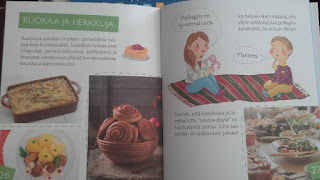


Swedish foods: Jansson's temptation (anchovy casserole),
meat balls, sweet cinnamon rolls

Funny thing about music though, in the Swedish book Abba is mention, in the Finnish book only Robin and Chisu, who are famous only in Finland. Where are HIM, Sunrise Avenue or Apocalyptica? I realize the book is meant for Finnish kids, but shouldn't they know these things, too?