Showing posts with label modern story. Show all posts

Thursday, October 6, 2016

Sami the dog chasing the big eater

Tapani Bagge 2008: Sami Hurtta suursyömärin jäljillä
illustrated by Jari Rasi


Sami the dog is a detective, who lost his sock. While trying to find him, he bumps into a big eater, who ate a wall of a gingerbread house. All kinds of strange things have gone missing and Sami has a real riddle in his hands. Luckily he has Jasmine, a small girl to help him out.

Finnish people read a lot of detective stories, especially from other Nordic countries. It is no wonder that the genre can be found in the children's section as well. Naturally the stories are not as grim as those for adults.


Tuesday, September 22, 2015

Secret Mushroombook, the lost notes of Professor Fungus

Julia Savtchenko 2014: Salainen sienikirja : professori Funguksen kadonneet muistiinpanot

Professor Cornelius Fungus is exploring the fascinating world of fungus with Mrs. Rimosa.  Together they find all kinds of intriguing mushrooms.

The book is a fictional "encyclopedia" that my boys found very interesting. Although I had to tell them that these kind of mushrooms do not really exist.

My favorite is the fancycollar mushroom which only appears in garden parties. Professor Fungus and Mrs. Rimosa had to throw garden parties in three different nights before this beauty appeared.  This mushroom grows in places, where it can sense the party atmosphere the best.


Boys favorite was the woolly milkcap with teeth (karvarousku in Finnish). It almost looks like the real thing, but has teeth.

The book is mysterious and fun. Besides all Finns a some point of theirlives pick mushrooms in the forest.


Friday, September 11, 2015

Otso and the toe eaters

Anja Portin 2015: Otso ja varpaansyöjät
illustrations by Timo Mänttäri

Otso is staying at his grandmothers and they have fish for dinner. Grandma tells Otso about the food chain: a krill eats plankton, a herring eats krill, a cod eats herring and human eats cod.

This starts to bother Otso: what will eat him? He tries to apply this theory: a bug that will be eaten by his soft toy, which then will be eaten by Grandma's cat. Then Otso will eat the cat and Grandma will eat Otso. Because Grandma's must be at the top of the food chain. Grandma laughs at him and the bug runs away and the cat couldn't care less.


Otso starts to imagine the creatures that will come and eat him.  Do they have bellybuttons? Will they use knife and fork? He can't sleep. Back at home dad reminds him about his name: Otso is a nickname to bear. That relieves Otso and he no longer is scared.

I guess it is universal that kids are afraid of bogeymen. And usually the fear is triggered by the strangest things.  I like the illustrations of this book and how Grandma's house really looks like Grandma's house.


Thursday, July 2, 2015

Pirate of Fog Island

Riina Katajavuori 2015: Sumusaaren merirosvo
illustrated by Christer Nuutinen

The story start, when the leading character tells us that his/her mother is a pirate: she has a golden tooth and she sings pirate songs and dances in high boots. There is also a curvy sword on the wall of his/her house.

The book is written in "I" perspective and the name of the child is never given. In my mind it is a small boy, but my sons think she is a girl. Fantastic Finnish language!

The child  studies the sea. She/he tells about the odd things, such as the blood of a crawfish is colorless, but when it is in contact with air, it turns blue.


One day the fishermen are dumping dead fish to the sea. They must be stopped: everything is getting sick.

The book has fantastic illustrations and the message is very important. Save the seas! Especially in Finland we are worried about the health of the Baltic sea.  It needs to be looked after.


Monday, June 15, 2015

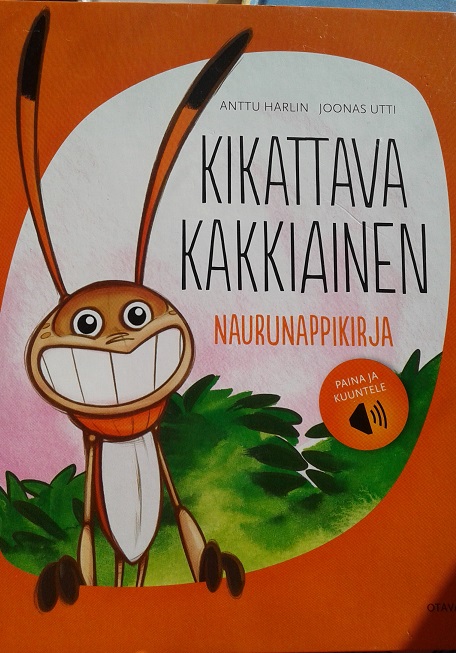
Gigglebug - laughbuttonbook

Anttu Harlin, Joonas Uitti 2015: Kikattava Kakkiainen

Gigglebug is playing with his/her friends. All it can hear is different laughter and when you turn the page, you can see, who made that sound.

Cute laughs, even though this book has thick pages, which in our house means its a baby book,  my five year old son likes this book.

We first met Giggle bug on an animation  at Pikku Kakkonen. I guess part of the charm is that "Kakkiainen" reminds us of  "kakka" which means poo. I like the delicate illustrations of the animation and this book.


Miss Hedgehog hiding in a mailbox. Mr. Moose in a bush.


 Gigglebug  also has a website.


Monday, June 1, 2015

Peter Robin puts out a forestfire

Tapani Karinen 2008: Pekka Punarinta sammuttaa metsäpalon

Peter the Robin is a very lively little bird. While playing in the forest with his friend, he sees an open fire. All animals panic and try to figure out what to do.

Peter takes action and puts out the fire, before the whole forest is on fire.

The very high lighted message of this book is that stupid humans left the campfire smoldering and did not put it out properly. Kids remember to take care of the nature.


This book is published in this century, but it reminded me of the books I used to read back in the 80s. I guess there is still need for educational stories. I also like the illustrations of this book. 


Monday, May 18, 2015

Pixon brothers and the homely glow of TV

Malin Kivelä 2013: Bröderna Pixon & TV:s hemtrevliga sken
Illustraded by Linda Bondestam


The four Pixon brothers love to watch TV and eat candy and chips. One day the TV does not work anymore and the boys have to come up with something else to do.

That is a bit troublesome, since they have the muscles size of a pea, but they do come up with imaginative things.

The books is a great example and an exaggeration of what happens when you watch too much TV. I guess the same goes for too much video games or playing with your phone. Exaggeration is a fantastic way of making a point and the illustrations remind me of the Addams Family.

I personally think the TV and actually the Finnish National Broadcasting Company have done a great job at least in educating people in languages: the foreign TV programs have subtitles and therefore we hear all possible languages from Chinese to Danish.  I started learning German with die Schwarzwaldklinik. But then again it is wonderful to watch TV in Germany, where  Fran Drescher and other Americans speak German.


Monday, May 4, 2015

Leapnights tram adventure -a children'd book about Helsinki

Annina Holmberg 2010: Karkausyön ratikkamatka lastenkirja Helsingistä
illlustrated by Virpi Talvitie

On leap night everything is upside down: the city does not belong to the people, but to a tram which flies through the city like the stars in the sky.

The Tram turns to Katajanokka, where the icebreaker Tarmo has engaged Sisu, speeds into Töölö, where a horse chestnut shakes nonsense (hölynpöly) around and makes people laugh.

The tram listens to the birds at Linnunlaulu and continues to Hietaniemi, where the beauty of the cemetery was dark and melancoly. At Ullanlinna  the tram celebrates with the robust rat and the formless pug and in  Käpylä the tram meets cone cows.

Hietaniemi cemetery
The dark and melancholy beauty of Hietaniemi cemetery.
The enamored tram realizes that the city has feelings, too. The story is  fairytale like confession of love to the city of Helsinki.

The story is full of delicious details, such as the horse chestnut shaking nonsense (hölypöly) instead of pollen (siitepöly), roteva rotta(robust rat) and muodoton mopsi (formless pug). I definitely look at Helsinki a different way now.


Tram in Töölö
I had never heard of the magic of the leap night before and I guess the story could have taken place on mid summer eve night as well. The the city is silent and beautiful.  Now that I think of it leap day is February 29th, there is no pollen then so nonsense is good to be spread then and not later in the spring.


Thursday, April 30, 2015

Harvest adventure

Olli enjoys several berries and fruit.
Irja Nikkinen 2010: Satoseikkailu : Olli Omenatoukan makoisat retket
illustrated by Jenni Lindfors

Saulus is an eager hiker. Suddenly he is joined by Olli Omenamato (Andy the Appleworm), who is very skeptical about anything new. Together they investigate the garden, nearby forest and even to the mire. They find all kinds of delicacies on their way.


Finnish swamp berries
Olli tells about the berries at the swamp
In the garden Saulus and Olli tend to the apple tree, taste different berries and even chocolate cherries. In the forest they find blueberries, lingonberries and cranberries and at the swamp they try cloud berries. Olli learns that new things are great and not so scary at all when you have a friend with you.


Finnish forest, forest berries
The readers are encouraged to find the items in the picture.
Finns have many berries growing in their gardens. Many go to the forest to pick some more, but not enough. Every year there are news about how many tons of berries are left to the forest, because people do not bother to go and pick them. Another debate happens, when the large frozen berry -producers flies berry-pickers from Thailand.  I always wondered about that too. We have so many unemployed people. Has anyone even asked them? May be the unemployed are afraid they loose their support from the state if they take these type of jobs.

Monday, April 27, 2015

Fox cub and the Great Shadow

Katariina Lempinen 2002: Ketunpoika ja suuri varjo


Little fox lives on a riverbank. One night he cannot sleep and wants to see the big world. It has rained and the bank is slippery. The little fox falls into the river. He meets many animals who are too afraid to help the fox cub home. They are afraid of the Great Shadow in the dark forest. The little fox gets scared, but he wants to go home. It turns out there is nothing to be afraid.


Similarities to Veikka's forest adventure are the fox and getting lost. This book about the Great Shadow describes fear and facing it more and uses fear of dark as an example. Many kids can understand that.

The illustrations of this book remind me of the illustrations of Hans Arnold.


Monday, March 9, 2015

Circus at the Library

Markus Majaluoma 2011: Sirkus saapuu kirjastoon

Ode to the Finnish Library institute.

There is a new intern at the library for the summer. The director instructs the intern, Maximilia that there is always a right book for whatever the customer wants. Then the director leaves for vacation. Maximilia opens the doors.

 First comes in a couple, a cat and a dog, pushing and shoving each other. The cat wants a book, in which the dogs are taught to sit still and not to pant at birthday parties. The dog wants a book, in which cats are taught to scratch the dog from the right place and to serve them real meat. Maximilia thinks real hard, but cannot figure out which book to give them. Then he picks up a book called “Fixing Gardens”. Nobody wants to eat meat after reading that book and it shows how to build a deck. The cat can host parties and the dog can have its own doghouse. The cat and the dog leave happy.

Next comes a lion, speaking in savo dialect. He wants to read a book about fishing. The lion is stressed out about being the ruler of the animal kingdom. Maximilian gives him “Oriental sitting practices”. It teaches how to sit still as in fishing.

Elephant wants a dieting book, because everyone laughs at it when it comes to stage. Maximillia hands out “The great Ballet syllabus”.

Clown comes in apologetic and is looking for a book about the diversity of human nature in literature. Maximilia picks up all the books that are taken out of circulation and piles them up in the clown’s big pants. The clown thinks it is a marvelous idea and plans on installing a reading light in there as well.

The pack of dog youth wants to use the internet. Maximilia gives them the passwords, but warns them not to surf the cat sites. It is strictly forbidden form dogs.

It is almost closing time, when Maximilia hears a small voice. Two lice want a tiny book. Maximilia gives them a microchip with all the books of the world. At home Maximilia picks a book and reads it. Any book will do.

Nowadays you can borrow anything from the library: board games, movies, video games, guitars, skies, skates, drills…. Needless to say, I appreciate library enormously. I guess it also gives the chance to read all the books in the world. And to quote Albert Einstein: “The only thing that you absolutely have to know, is the location of the library.” That is so true.

 I have always wondered, why you cannot return a book back to the store, if you do not like it. You can return almost anything, except books and movies. I have stopped going to the movies, because the tickets are so expensive and most of the movies are so violent that I do not consider them entertainment anymore. How is killing entertainment anyways? There is enough violence in the news. Anyway, I hate to buy a book only to realize that is wasn’t a good book after all. Library solves that problem. I borrow a book and if I like it, then I buy it. This is great with childrens’ books. We test read the library book and then if the boys (or I) like it, then I buy it. I also like the e-books that do not take any self spaces. We have too much stuff as it is. Even though, I do not think there is ever too many books.


Friday, February 27, 2015

Beastbook

Suvi Vehmanen: Lapsen oma petokirja 2010
Illustrated by Laila Nevakivi

Little troll Ylli gets lost in the forest.Miihkali and Virve Forest elves are making a snow forest, when Ylli finds them. Miihkali and Virve ask him to stay with them.

 A wolwerine Hanna is making a nest for her offspring. She invites Miihkali, Virve and Ylli to her new home, and the cubs are born into the snowcave.

One night Miihkali hears the wolves. He and Virve go visit them. The wolves are starving and are worried about the trolls, who are after them. Miihkali and Virve tell Ylli about the wolves’ problems with the trolls.

The wolves gather to discuss what to do: there is an injured elk and the wolves smell the trolls, they too are somewhere near. The wolves debate whether to run or hunt. They decide to get some food.

The trolls hear the wolves and they fight among themselves if they should hunt for the elk or go after the wolves. The elk hear the troll’s bickering and leave.

 The wolves catch the injured elk and everyone gets to eat. On their way home, the trolls attack and capture small cub, Hermanni. Ylli arrives just in time to defend Hermanni. The trolls blame the wolves for stealing their food. It turns out that the trolls have been making up stories about the wolves. Miihkali and Virve arrive with the wolf pack. The wolves and the trolls make a deal: the wolves will teach the trolls how to hunt and the trolls stop chasing the wolves.

Playing hide and seek with weasel and stoate.
Spring arrives and the nature blooms, birds are singing. In June the wolf cubs investigate their environment as do the wolverine cubs. Wolf mother tells about bears and foxes. Miihkali promised in winter to weasel and stoate that he’ll play hide and seek with them in the summer. In the winter he thought that it was too easy for them to hide. It is not easier to find them in the summer either, because they change color. Ylli is hiding with lynx at the top of the tree. Ylli returns to his family and the leader wolf promises that he can take Hermanni with him. Hermanni is domesticated and his offspring will be dogs.

At the end of the book is a menu for predators: the appetizers, main courses and deserts. There is also pictures of the tracks and droppings of different animals, so even if you do not see the animal itself, you can see witch animal has been walking in the forest.

Basically this book is about wolves. The other beasts are described briefly. The illustrations of the book show also other forest animals and vegetation.

In some parts of Finland the wolves are feared greatly. I live in so in densely populated area (in Finnish scale) that I have no reason to fear them and I can easily say: “Live the wolves alone!” But I understand that in the northern and eastern parts of Finland the wolves come so close and have killed sheep and even dogs that they are considered troubling.


Tuesday, February 24, 2015

Dance of forest mouse

Pirkko-Liisa Surojegin 1990: Metsähiiren tanssi

 The forest animals have benn picking up mushrooms and now they are planning to have a party.

The forest mouse has been on a foul mood all day: he/she hasn't picked any mushrooms and does not want to attend the party. The others try to persuade it to join them, but then leave it alone.

The forest mouse lies on the ground feeling small. Suddenly the wind blows leaves on top of it. The mouse starts to chase them, jumping, bouncing. It looks like dancing. The rabbit admires mouse's dance, it has returned to get the mouse to the party. The mouse joins the others.

The rabbit shows the others how the mouse was dancing. And soon all the animals are dancing. The forest mouse is feeling light and happy. It eats soup as much as it can from all the laughing.

Dancing is something that Finns are not comfortable doing. But dancing is the only way to get real close to another person. The Finnish tango is in my mind the most romantic dance there is. You must not confuse it with the Argentinian tango, since the Finnish tango resembles slightly the German march. Any way the magic of Finnsh tango can only be experinced with the right person. And that is the hardest part in dancing.

Picking up mushrooms is something very Finnish, too. The forest are full of these super food, the only down side is that you really have to look for them. The mushrooms are not jumping to your basket, but you really have to look for them. But it is also very rewarding, when you first see a small yellow spot between the straws and suddenly you see the whole ground covered with golden chantarelles.

Thursday, February 19, 2015

Where are you going, mitten?

Suvi-Tuuli Junttila 2014: Minne matka, lapanen?


 Mitten gets lost. He/she wonders around and first finds an acorn. Together they have an adventure in the winter wonderland and find a cork. They are scared by a big dog, almost drowned before they end up at wasteland.

There is another mitten and many other friends. Acorn is not happy and continues to look for a place to settle.


This book is illustrated by photographs taken from miniature worlds. The details create a fantastic feel of getting lost in the big world. And sometimes the snow resembles wool tassels.

Of course the Finnish melancholy is present.


Monday, February 9, 2015

Hidden Valley

Cover of Hidden Valley book
Pamela Mandart 2007: Piilolaakso
Pamela Mandart 2008: Piilolaakson talvi
Illustrated by Cara-Maria Knuutinen

Hidden Valley


Emma and Eino are siblings and they have recently moved to a new home. Luckily they have each other. One day they are playing with a ball and the ball vanishes inside a tree. The children see a bottomless pit in the tree and they fall in.


Emma and the animals look for Eino.
They find themselves in a strange forest with odd plants. Then they see a creature that looks like a hippo. Other strange animals appear and Emma asks them, who they are. All of their last name is Moeritherium, firstnames are Moorit, Meerit and Beerit . Emma realizes that they are prehistorical animals.

The animals get excited about the ball and soon they are playing together. Again the ball is nowhere to be found and they start looking for it. Eino gets lost and Emma is worried. Moorit suggest that they ask the trees. The trees help them find Eino and the ball.

The animals through a party to Emma and Eino, but soon they have to get back home. Emma’s and Eino’s parents do not believe them, but the children decide that when they grow up, they will become scientists and prove that Hidden Valley exists.


The winter of Hidden Valley book cover

Winter of Hidden Valley

It’s almost Christmas and Emma and Eino decides to take some Christmas spirit to the Hidden Valley. they pack elf caps, scarfs and decorations. The slippery tree is almost impossible to climb into.

Dad Dino sees the caps in the children’s heads and wonders, if they have grown tails in their heads. Emma explains the caps and gives everyone a cap. The children ask the animals to come and see the snow.


Animals from Hidden Valley enjoy winter -for a while.
Animals of Hidden Valley
The animals have never seen snow and are amazed. Eino gives them scarfs and soon they are playing in the snow: tobogganing, building snowmen. Then the cold gets to the animals and they return to the Hidden Valley. Emma shows them the decorations and they decorate a Wollemi pine. The children return home and still the parents do not believe them.


In Finland the grown ups are dull, too. They do not belive all what their children say, but that doesn't stop the children from imagining things.

I guess the second book tries to prove that snow can be fun, if you are dressed properly. There is no such thing as bad weather, just wrong attire.


Monday, February 2, 2015

Icebreaker Sisu

Sisu and mission in the Baltic Sea
Teemu Leppälä 2013: Jäänmurtaja Sisu ja tehtävä Suomenlahdella and Jäänmurjata Sisu ja Hailuodon arvoitus
illustrated by Petri Kantoniemi

Icebreaker Sisu and mission in the Baltic Sea 

Icebreaker Sisu is anxiously waiting to rescue ships from the ice. He and other Icebreakers Voima, Urho, Kontio amd Otso are waiting to be called to the rescue. Voima is the eldest, most respected icebreaker and Otso and Kontio are the juniors (built in 1986 and 1987 respectively) In comparison to Disney/Pixar Cars, the icebreakers are slow moving. However their jobs are very important at least to Finland. Many goods come to Finland via the Baltic Sea.

We finns take icebreaking very seriously. There are only few things we can be proud of and this is one of them. The book describes very clearly how the ice that to us civilians seem to be standing still can actually take ships miles away, to places they do not wish to be in.

Icebreakers waiting for an assignment.
This book opened my eyes in many ways: I definately am a country girl. In the book the location of the icebreakers are in Katajanokka, near the city. I thought Katajanokka is at the city center. Little do I know! But that is correct: the city center of Helsinki is right next to Katajanokka.

 The other geographical issue that had me guessing is the name of the most northern harbor of Bothnian Bay. Is it Töre in Sweden or Tornio in Finland? I guess these are just details.

Cover of the second book

Icebreaker Sisu and the mystery in Hailuoto

This book takes place in Hailuoto, a small island in front of Oulu. Sisu is taking three ships to north. He hears that Kontio is coming south toward him with two ships. They plan to meet and then switch their customers.

Lighthouse Ms. Marjaniemi ( The name of the Hailuoto Lighthouse) sees something odd at the north side of Hailuoto. She alerts hydrocopter Harri to check it out. The Bay of Bothnia is busy in winter and it is important that the routes are planned carefully and everyone knows where they are supposed to be. These surprises can be dangerous.


Harri the hydrocopter is loud.
Harri cannot see anything, but the ice starts to break and an old wreck pops from the ice. The pack ice has loosened it from the bottom. Now it has to be removed from the passage. Otso, Sisu and Kontio come and help remove the wreck.

This second book is much more exciting. I was sure that the odd shape was a Russian submarine. The writer's solution was much better. This book also proves that I know nothing of Oulu region, so I cannot say about the geography of this book. I found it also fabulous, that Ms. Marjaniemi, the light house was wearing a military helmet and a fur collar. Nice touch.
Sisu and his colleagues.


The real life fleet at the Baltic Sea.

The significance of the icebreakers can also be heard in the Finnish version of the yellow submarine by the Beatles: Keltainen jäänsärkijä sung by Simo Salminen and Spede Pasanen.

Monday, January 26, 2015

Ghost stories of Grandpa Elf

Eero Ojanen 2008: Tonttuvaarin kummitustarinoita
illustrated by Ari Jokinen

Old ghost stories told by a Grandpa Elf. He tells in the book stories that happened somewhere else. Where he lives, nothing ever happens.

The atmosphere is created by the first story, where someone is breathing in your neck. Then a barn is haunted by a horse and the cudgel of death.

Then Granpa Elf tells a story about a horrible rider, who has been seen to ride toward the manor.

The story of the guards of the treasure can be also read in the Mauri Kunnas: Tales from Doghill.

Ghosts' Christmasparty
The story of the strict landowner tells what happens, when you do not treat others so nice. When he died, his body couldn’t be carried into the church: the doors wouldn’t open.

At the border of two villages is haunted by someone, who moved the border posts. Someone hear whining. They find a body, it is buried and the whining stops. One hears clinking and they find stolen property.


 At a dangerous cross roads white lady keeps asking not to leave her.

At Chirstmas the deceased celebrate at the church. When the dawn comes, the church is empty.

A shoemaker is the first to be buried in a cemetery. He was a very colorful character, who even after his death makes pranks to those who walk by the cemetery by night.

At this point Grandpa Elf wonders if there is ghosts if no one sees them. Grandpa Elf tells that nightmares are created when someone presses the sleeper hard, so that the sleep is disturbed and the sleeper feels distressed. The Finnish word for nightmare is painajainen and to press is painaa. So there for some presses us when we have nightmares.

Lapland is the place to have prmonnitions.
Lumbago in Finnish means Witches arrow (noidannuoli) and it was believed that witches shoot people with arrows and that causes the pain in the back. Other diseases are transmitted the same way. When someone looks ate you with the evil eye, you feel strange tingling. When objects are nowhere to be found, a spirit has taken it.

Premonitions are only seen in places where there is not a lot of movement, as is in Lapland. In a house, the people knew that someone was coming, before they could be seen. The wife told the guests that she had heard noises and seen these guests, who had then disappeared. Soon the real people had arrived.

Boogeymen lurking behind the outhouse.
Boogeymen are told to be seen in the dark. At the time, when toilets had separate outhouses, the kids were afraid to go there, because in the dark was boogeymen in the dark.

Ghost were seen, where people were. But then they disappeared from the Southern and then from the Western Finland. Most ghosts were seen 100 years ago. Today not so much.

Finland has few castles and many manors. The ghosts in those were appreciated. In the past, people were very afraid of ghosts, now a place isn’t distinguished or classy if it does not have its own ghost. For example the Olavinlinna in Savonlinna is haunted by a girl, who had been masoned in the walls, because she had let the enemy in the castle. She was innocent and now she is haunting the castle. In Hämeen linna haunts the sister of the chief that build the castle.

Today ghost have hard time finding jobs. They have lost their motivation, because no one is interested in them anymore. People find excitement elsewhere. Or maybe people are not afraid anymore. The ghosts have become technical. The Finnish word painovirhepaholainen means devil typo. People are not making mistakes, there is always something (aka the devil) that makes the mistakes. There is always light and noise, people are in a hurry. There is no place for ghosts. Grandpa Elf wonders, if he is really silent and paying attention, would he still see ghosts.


Thursday, January 22, 2015

My own small little

Ulf Stark & Linda Bondestam 2014: Min egen lilla liten


In a dark and gray cave lives a Creature. Its eyes and skin can’t stand light. Every time it goes outside in the daytime, it feels a little sick, and then real sick, then it dies. Creature is gray like the mountain where its cave is. And it is all alone. Little Spark, who came from the Sun breaks into the Creature’s darkness and shows it colors and light. But Spark lives only one day, then it has to return and leave its friend, Creature.

The tone of the story is shining with melancholy, wistful and poetic.
The story reminds me of Pessi and Illusia as well as the children’s song Menninkäinen and Päivänsäde (Ray of light and the forest troll)

I do not understand why my boys want to read this book over and over again. To me, its just too sad to be a good fairy tale. It reminds me too much of real life: you have a quick view of something that you cannot have and then it is taken away from you. I had to write about this book, because it so well describes the Finnish mentality: we are gray creatures and when someone flashy and bright comes we are amazed. And in the end, we are content to live in our little gray caves, because we have to, otherwise we die. Or so we think, the Creature has no choice.


Monday, January 12, 2015

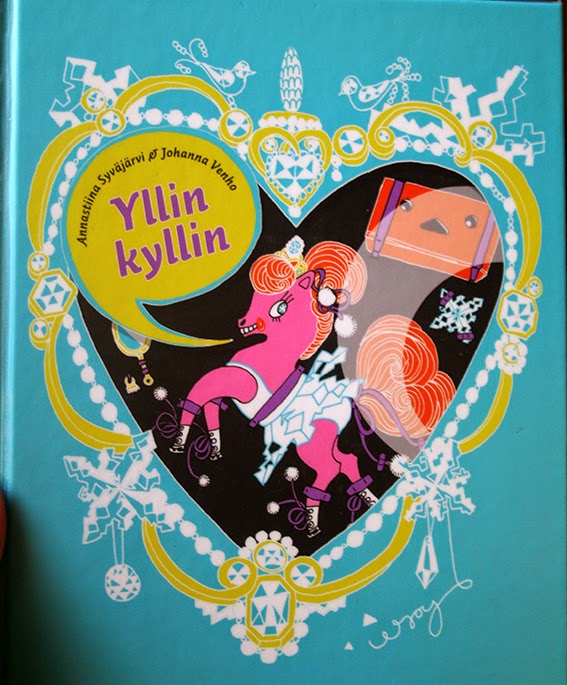
Enough and to spare

Illustrated by Annastiina Syväjärvi 2012: Yllinkyllin
text by Johanna Venho

Little girl named Kylli is moving. She finds a catalog that has a picture of a pink toy pony. She wants it and she wants it bad.  Her mother is telling her that she can't have everything she wants. But Kylli's Mother's actions tell otherwise: she is complaining about the old couch, wanting  a new one and she has plenty of unnecessary things.

Kylli goes to play outside and finds a new friend and the pink pony is forgotten.


Colorfully illustrated, very educational story about too much stuff and how adults are sending mixed messages to children. After all what is the most important thing in children's lives or for adults for that matter?


Friday, January 2, 2015

Walk this world

Jenny Broom 2013
Illustrated by Lotta Nieminen

The book celebrates different cities. All very different all colorful. Every spread introduces a new city from Helsinki to Sydney.

All citys have flaps so the reader can see inside the buildings.


Helsinki

Fascinating is that Helsinkin is surrounded by forests. That maybe true. I also enjoy the onion domes of the Red Square and the very recognizable Sydney Opera House.