Showing posts with label Topelius. Show all posts

Friday, December 5, 2014

The Old Elf of Turku Castle

Zacarias Topelius 1849 first published in the third “Sagor” –collection.: Turun linnan tonttu-ukko
illustraded by: Kirsi Tapani 2002 The old elf of Turku

Castle is the eldest in Finland and is the most famous of the elves. He lives in Turku Castle, in Hollow tower, where the air is nice and musty. The elf visits the elf at Turku Cathedral every 20 years.

His best friend is Matti Kivinen, who accidently ran into the elf in one of the passages of the Castle. At the time Matti was 12. Since then Matti become the caretaker of the Castle. The wind as well as time tears the castle. Winter snows in, spring rains in, the rats chew holes to the floors. The elf has been fixing the castle and now he has Kivinen as his help.

The Old Elf decorates the Turku Castle for the wedding
The elf has seen Saint Eric and Henry, the court of Duke John, the captured King Eric and Per Brahe. And he tells stories of the war, siege. The great fire of Turku happened when the elf was visiting his cousins at Häme and Raasepori Castles. He won’t leave again. The elf shows Kivinen his treasure, many who have attempted to steal it are now in chains.

Soon there is a wedding at the Castle: the grand-daughter of Kivinen is getting married and the elf has given her a beautiful crown. The guests are sure that Kivinen has found it in the Castle. Kivinen drinks too much and starts to tell about the elf to Saara Kouranen, whose need to gossip is trumped by her greed.

Saara and her son start to look for the treasure. The elf stops them and turns Saara into a cat and her son into a wolf. Kivinen doesn’t see the elf again, and the elf is no longer friendly toward the inhabitants. The flowers are no longer watered and the walls are not repaired. The elf is tired. Rose, Kivinen’s grand daughter promises to the elf that her son will take care of the castle. The castle of Turku laughs at the tooth of time.

 This was the classic Zacharias Topelius fairytale. There are two modern stories about the old elf at the Turku Castle as well. The secret of the old elf and the Old Elf’s miracle of Christmas.

Sinikka Sajakorpi
illustrations Taru Castrén:
Turun linnan tonttu-ukon jouluihme 2001
Turun linnan tonttu-ukon salaisuus 2002

The Christmas Miracle of the Old Elf at the Turku Castle. 

The old elf walks around the casle and meets ghosts of people that have lived in the castle. They meet the three Catherina’s that lived there in different times. Skapula the parrot was brought to the castle 500 years ago to entertain people. And the small monkey Talapoi was every one’s favourite. The old elf and his cat go visit pre-cat at the Aboa Vetus museum.


The greate Christmas tree
at the Turku Cathetral
The Precat tells them stories about the time when he lived in Turku. Next the elf and his cat sneak into the Pharmacy Museum to get a recipe for a pill that will make all the people happy and glad. The pill was invented over 3000 years ago.

 The Turku people eat the pills and become friendly and happy. All except Grumpy old man. He plans to create a balloon of bad mood and blow it up over the great Christmas tree near the Turku Cathedral, when the declaration for Christmas peace is read.

The old elf of Turku Castle hears about this and tells Santa Claus about the plan. Santa Claus’s reindeer grabs the balloon and takes it away. The old elf asks the Grumpy Old Man to have dinner with him. The Grump tells the Old Elf that he has no home. The old Elf arranges Grump to live at the Luostarinmäki Handcrafts museum.
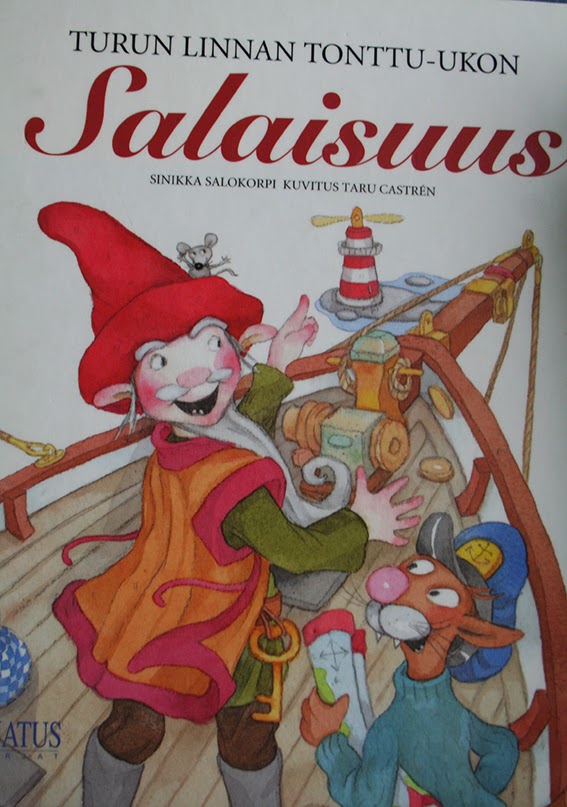

The secret of the Old Elf of Turku Castle 

The Cat of Old Elf wants to go sailing. The Old Elf knows there is a maritime museum at the banks of Aura river and they could borrow a ship from there and go great Christmas Pike.
The ship sings and takes them to the Pike lighthouse. The lighthouse keeper seagull takes the to a near by rocks and the Christmas Pike comes to fetch them. The Old Elf and the Cat eat peaces of magical chocolate that allows them to breathe underwater.

The Christmas Pike shows them pikeschool, gift shop and hospital. Christmas Pike thinks that people should learn to keep the environment clean. Traditionally Christmas Pike had sent his greetings to the king. But then that tradition stopped, when the Russians ruled Finland. President Kekkonen returned the tradition that the Turku area locals bring a Christmas Pike to the President.

The pike hospital.
The Old Elf and the Cat return to Turku Castle. Christmas Pike comes to see them on the same trip, when he brings his greetings to the president.

 I had never heard of the Old Elf of Turku Castle, before I started to look for Finnish Christmas stories. This just proves, how isolated the Turku culture is from the cultures of the rest of the Finland. Or then rest of the Finland does not want to know anything about Turku. That is sad. The two newer books about the Old Elf tell fascinating details about Finnish history. After all Turku was the most important city during the Swedish regime.


Wednesday, April 23, 2014

Ant that went to the doctor's

Z. Topelius: Myran som for till doktorn
Illustrated by Aleksander Lindeberg 2011
In Finnish: Muurahainen joka lähti lääkäriin

An old fairy tale about a child ant that breaks his leg. His mother is takes him to town to look for help and finds a doctor who can do that with the help of a grasshopper.

The mother never gives up and the child finally gets his leg back.


The story's lesson is never to give up and if you want something work hard at it. This seemed to be Topelius' main purpose in his stories: to teach the children about life.


Are the modern fairy tales just for fun or do they have some deeper meaning as well? I am glad that these old stories still get published. In some way they are part of our cultural history and maybe some child will learn someting. At least they can enjoy the fantastic illustrations of Alexander Lindeberg. He illustrated this book back in the 1960s, but the book got published only few years ago.


Monday, January 27, 2014

Adalmina's pearl

Illustration by Lena Frölander-Ulf 2012
Adalminas pärla, Finnish: Adalmiinan helmi 1853
Another fairytale from Topelius. Written in 1878-1896

When Princess Adalmina is born, two fairy godmothers give her gifts. The first gift is a pearl that makes Adalmina wise, rich and beautiful. The other godmother gives her a humble heart if the Princess ever loses the pearl. The King makes a diadem for the pearl and Adalmina wears it all the time. Adalmina grows up, but instead of her beauty and wisdom, she is very arrogant. She is forbidden to leave the palace garden and she is furious.

Adalmina loses the diadem
She leaves the castle and walks to the nearby forest. There she sees a pond and she stops to admire herself. The diadem and the pearl with it falls into the pond. All at once Adalmina forgets who she is. She is poor, dumb and ugly. She wonders around the forest and finds a small cottage, where an old woman lives. She is happy there.

Meanwhile the king and queen are devastated: they look for Adalmina all over. They even promise to give her hand in marriage if someone finds her. One day a prince rides in the forest. First he finds the diadem at the pond and then the cottage and meets Adalmina. He wonders why the girl is so endearing and moves his heart even though she is ugly. He asks if the ladies have seen Adalmina. They say no.

The prince takes the diadem to the King. The diadem fits only Adalmina and the King as he still remembers the second fairy godmother’s gift, orders all the girls of 18 to come and try the diadem on. At the end of the day they look at the road if there still were someone coming.

Finally Adalmina comes and tries on the diadem. It fits and then she remembers everything. She also remembers how arrogant and gruel she was before. But now she also remembers what it was like living in the cottage. She has learned a lesson and now she can live happily ever after with her prince.
Albert Edelfelt
Adalmina's pearl by Albert Edelfelt, 1903 Cover of Läsning för barn -illustrerad ac finska och svenska konstnär. (Lukemisia lapsille,  translated in Finnish  1906-1907)
Illustration by Alf Danning


Rudolf Koivu's Adalmina's pearl
Adalmina by Maija Karma

Illustration by Maija Karma

Illustration by Maija Karma

Friday, January 24, 2014

The stolen princess: a fairy tale from Persia

Zacharias Topelius 1848
told in Finnish Irja Lappalainen and Antonia Ringbom 1986
Illustrations Antonia Ringblom

The old Persian king has only one daughter. The daughter is very blond (hence the name Kultakutri = Goldilocks in Finnish), which is rare in Persia. Her mother was stolen from North and sold to the King. One day there is a animal festival where a tiger is killed. The curious princess goes closer to see. But the tiger is a witch from Lapland, whose mission is to rob the princess. The mission was given by Bom-Bali, the old King’s enemy. Bom-Bali is so low that the King doesn’t even want to cut his beard not to mention his throat.


Instead of taking the princess to Bom-Bali, the witch takes Kultakutri to his home and wants her to marry his son. The Princess refuses and the witch tries to break her by closing her into a cave. He gives her only 30 cloud berries to eat and 30 drops of morning dew to drink. He diminishes the portion every day. He also gives her company: mosquitos. The witch’s wife and son give the Princess some reindeer meet to eat. The witch is furious and fnally he turns the Princess into heather. Soon there will be frost and the princess will die.

Alas there is a prince who has been looking for the Princess. From a bird he hears that the Princess is in Lapland. Prince finds the witch, who dies. The witch’s wife and son tell the prince that the Princess is heather and tell him how to reverse the spell. The Princess is rescued. The Princess and the Prince promise the two a palace in Persia, but they refuse. What would they do in Persia? Lapland is the best place on earth.


Illustration by Alf Danning
 The story was written in Swedish, the original name is Prinsessa Lindagull, in Finish the name is Prinsessa Kultakutri (note that princess is the same in Swedish and Finnish). Kultakutri is also the translation for Goldilocks (and the three bears) so it is a bit confusing. It shouldn’t be: there are lots of Johns out there, but in fairy tales it is disturbing.

 The other names in the Finnish version of the fairy tale are odd: the witch is Hirmu, his wife’s name is Pimpendora and his son’s name is Pompenpaturi. But then again it adds a little more mystique to the fairytale than if the names were Jane and Jim.